
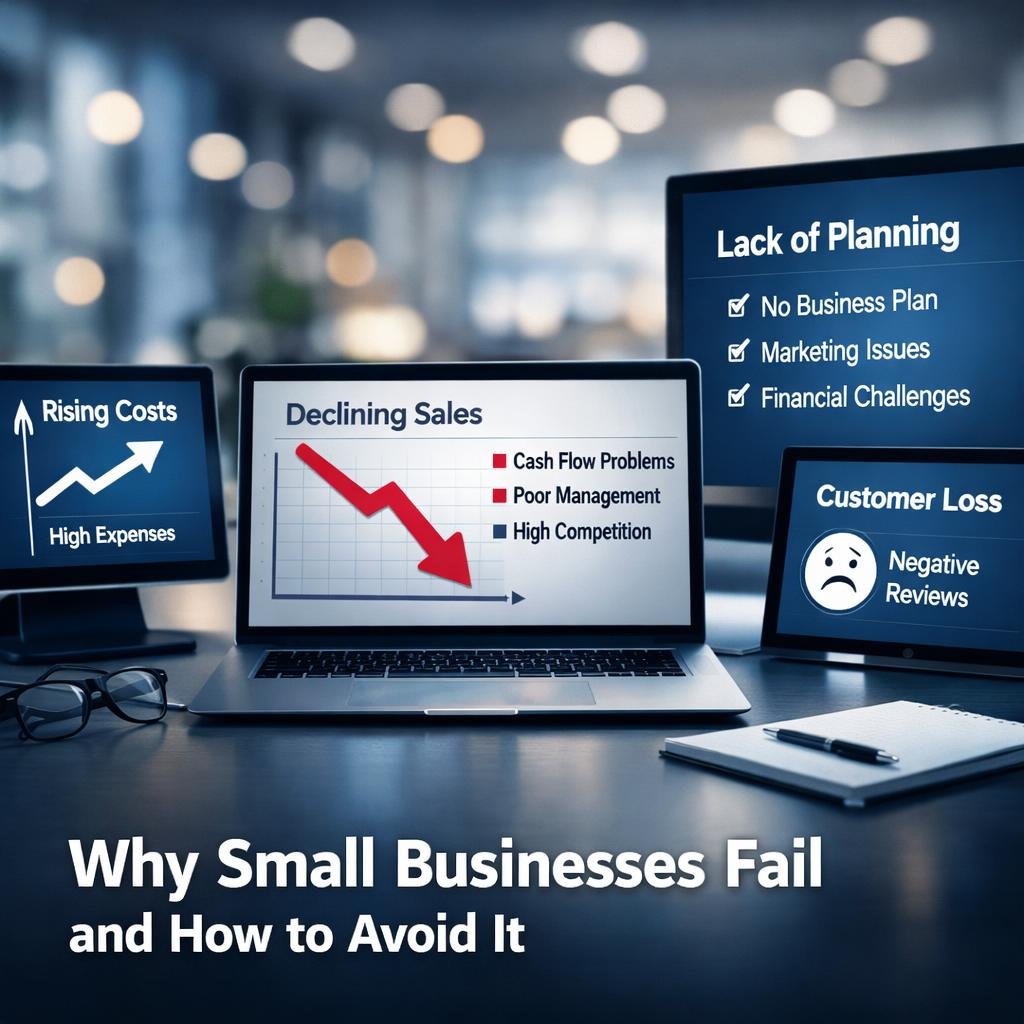
Starting a small business is one of the most rewarding things a person can do. It offers freedom, purpose, and the chance to build something meaningful. But the reality is that a significant portion of new businesses do not survive their first few years, and understanding why is the first step toward beating those odds.
Most small business owners go in with passion and a solid idea. What they often lack is a clear-eyed view of the obstacles ahead. The difference between businesses that thrive and those that collapse usually comes down to a handful of repeatable, avoidable mistakes — not bad luck.
This article breaks down the most common reasons small businesses fail, organized by category, so you can spot the warning signs early and take action before small problems become fatal ones. If you are still in the planning phase, learning how to build a business plan that actually works is one of the smartest investments of time you can make right now.
Understanding Why Small Businesses Fail
Defining “failure” and how it shows up in real businesses
Small business failure is not always a dramatic shutdown. Sometimes it looks like a business that limps along for years, never profitable, draining the owner’s savings and energy. Other times it is a formal closure, bankruptcy, or a forced sale at a loss.
The business failure rate varies by industry, but data from the Bureau of Labor Statistics consistently shows that a large share of new businesses close within the first five years. That number is not meant to scare you — it is meant to inform you.
| Stage | Common Failure Signs | Primary Cause |
|---|---|---|
| Early Stage | No customers, no revenue | Poor market research |
| Growth Stage | Cash flow problems, chaos | Weak financial management |
| Mature Stage | Declining margins, stagnation | Outdated business strategy |
Myths about failure versus what research actually shows
One persistent myth is that most startups fail because of bad ideas. Research tells a different story. The idea is rarely the problem — execution, funding, and market timing are far more common culprits.
Another myth is that failure is permanent. Many successful entrepreneurs experienced startup failure before finding their footing. The business owner who learns from a failed venture often builds something far stronger the second time around.
Business statistics also challenge the idea that failure is random. Patterns emerge clearly across industries, and most failures share a recognizable set of root causes.
Market and Strategy Mistakes
Weak product–market fit and limited demand
The most fundamental reason businesses fail is that not enough people want what they are selling. This is called poor product–market fit, and it is shockingly common even among well-funded startups.
Many entrepreneurs fall in love with their product before validating whether a real customer base exists. They skip the market research phase, assume demand, and build before testing. By the time reality sets in, they have spent their working capital on something nobody needs.
The fix is simple in theory but requires discipline: talk to real potential customers before building anything significant. Validate demand with small experiments before committing major resources.
Poor understanding of customers, competitors, and positioning
Even when demand exists, many small business owners fail to understand who their ideal customer actually is. They market to everyone, which effectively means marketing to no one.
Ignoring competition is equally dangerous. A business that does not know its competitive landscape cannot differentiate itself, price correctly, or defend its market share when a stronger player enters the space.
Positioning matters enormously. Customers need a clear reason to choose you over alternatives. Without a compelling, specific value proposition, your marketing strategy will always underperform.
Flawed or missing business model and strategic plan
A business model defines how a company creates, delivers, and captures value. Many small businesses operate without one, relying on intuition rather than a structured approach to generating revenue.
Without a clear business plan, owners make reactive decisions instead of strategic ones. They chase every opportunity, spread themselves thin, and never build the focused momentum needed for sustainable business growth.
A documented strategy forces clarity. It makes you define your target market, your revenue model, your cost structure, and your competitive advantage — all before you spend significant money.
Financial and Operational Mismanagement
Cash flow problems, undercapitalization, and bad budgeting
Cash flow problems are the single most cited reason for small business failure. A business can be profitable on paper and still run out of cash if money is coming in too slowly or going out too fast.
Undercapitalization is a related issue. Many entrepreneurs underestimate how much money they need to reach profitability, and they launch without enough runway. When unexpected costs hit — and they always do — there is no buffer.
Bad budgeting compounds both problems. Without tracking actual versus projected spending, small business owners lose visibility into their financial position until it is too late to course-correct.
Pricing, margin, and inventory mistakes that drain cash
Pricing is one of the most misunderstood elements of financial management. Many small business owners underprice their products or services to win customers, not realizing they are destroying their profit margin in the process.
Inventory mismanagement is another silent killer. Holding too much stock ties up working capital. Holding too little means missed sales and frustrated customers. Both scenarios hurt revenue and cash position simultaneously.
Debt management also plays a role here. Taking on too much debt too early, especially at high interest rates, creates fixed obligations that strangle a business during slow periods.
Chaotic processes, weak systems, and inability to scale
Operational costs spiral when there are no systems in place. Every task gets reinvented from scratch, errors multiply, and the business owner becomes the bottleneck for every decision.
Businesses that cannot scale are businesses that cannot grow. If adding one new customer requires a proportional increase in owner time and effort, the model is broken. Systems, documentation, and delegation are what allow a business to grow without falling apart.
Many small business owners resist building processes because it feels bureaucratic. In reality, good systems are what create freedom — for the owner and for the team.
Leadership, People, and Culture Challenges
Inexperienced management and owner bottlenecks
Poor leadership is one of the most consistent factors in small business failure. This does not mean the owner is a bad person — it means they may lack the specific management skills needed to run and grow a company.
Many entrepreneurs are excellent at their craft but struggle with the business side. A great chef can open a restaurant and fail because they do not understand food cost percentages, staff scheduling, or customer acquisition. Technical skill and business acumen are different things.
Owner bottlenecks are a specific version of this problem. When every decision flows through one person, the business cannot move fast enough to compete or respond to change.
Hiring missteps, misaligned teams, and toxic cultures
Hiring the wrong people is expensive in every sense. Bad hires drain time, money, and team morale. They slow down operations and create friction that ripples through the entire organization.
Culture is not a soft concept — it directly affects performance. A toxic or misaligned culture drives away good employees, reduces productivity, and eventually damages the customer experience. Small business owners who ignore culture pay for it in turnover and lost business.
Building a strong team requires clarity about values, expectations, and accountability. That starts with the entrepreneur setting the standard from day one.
Resistance to change and reactive decision-making
Markets shift. Customer preferences evolve. Technology disrupts established models. Businesses that refuse to adapt do not survive these changes — they become cautionary tales.
Reactive decision-making is the opposite of strategy. It means responding to crises instead of anticipating them, which keeps the business in a constant state of firefighting rather than forward momentum.
The most resilient small business owners build habits of regular review and honest assessment. They ask hard questions about what is working, what is not, and what needs to change before problems become emergencies.
External Pressures and Risk Factors
Economic shocks, industry shifts, and disruptive competitors
No business operates in a vacuum. Economic downturns reduce consumer spending, tighten credit, and increase competition for a shrinking pool of customers. Businesses with thin margins and no cash reserves are the first to collapse.
Industry shifts can make an entire business model obsolete almost overnight. Competition from larger, better-funded players or from technology-driven disruptors can erode a customer base that took years to build.
The businesses that survive external shocks are the ones that maintained financial discipline during good times. Reserves, diversified revenue, and adaptable models are the best defenses against forces outside your control.
Overreliance on key customers, suppliers, or channels
If one customer represents fifty percent or more of your revenue, you do not have a business — you have a dependency. Losing that customer can be immediately fatal, and the threat of losing them gives that customer enormous leverage over your pricing and terms.
The same logic applies to suppliers and distribution channels. A single-source supplier who raises prices or goes out of business can disrupt your entire operation. A platform that changes its algorithm can eliminate your primary marketing channel overnight.
Diversification is not just a financial concept. It is a survival strategy for every dimension of your business model.
Legal, regulatory, and compliance pitfalls
Many small business owners underestimate the legal and regulatory complexity of running a company. Employment law, tax obligations, licensing requirements, and industry-specific regulations create real risk for those who are not paying attention.
A single compliance failure can result in fines, lawsuits, or forced closure. These are not hypothetical risks — they end businesses regularly, often ones that were otherwise performing well.
Investing in proper legal and accounting support early is not an overhead expense. It is risk management that protects everything else you are building.
Conclusion
Key patterns behind most failures and what they have in common
Looking across all these categories, a clear pattern emerges. Most small business failures are not caused by one catastrophic mistake. They result from several smaller problems compounding over time — poor planning, weak financial discipline, leadership gaps, and an unwillingness to adapt.
The businesses that survive share common traits: they validate before they invest, they manage cash obsessively, they build strong teams, and they stay honest about what is not working. Business success is rarely accidental.
Practical steps owners can take to improve survival odds
If you are starting out, the most important thing you can do is build your business on a solid foundation from the very beginning — with validated demand, a clear model, and enough capital to reach profitability.
If you are already operating, conduct an honest audit of your cash flow, your team, your customer concentration, and your competitive position. Most problems are fixable when caught early.
- Track cash flow weekly, not monthly
- Validate product–market fit before scaling
- Document your core processes and delegate systematically
- Diversify your customer base and revenue streams
- Invest in legal and financial guidance early
The goal is not to eliminate all risk — that is impossible. The goal is to make informed decisions, build resilience, and give your business the best possible chance of long-term survival.
FAQ
What is the single most common reason small businesses fail?
Cash flow problems consistently top the list. Even profitable businesses can fail if they run out of cash before revenue catches up with expenses. Poor financial management and undercapitalization are closely related contributors.
How soon do most failing small businesses run into serious trouble?
According to Bureau of Labor Statistics data, many businesses that ultimately fail begin showing serious warning signs within the first two to three years. Early-stage cash shortfalls, inability to attract customers, and operational chaos are the most common early indicators.
Can a struggling small business realistically be turned around?
Yes, but it requires honest diagnosis and fast action. Many turnarounds succeed when the business owner identifies the core problem — whether it is pricing, cash flow, team issues, or market fit — and makes decisive changes. Waiting too long is what makes recovery impossible.