
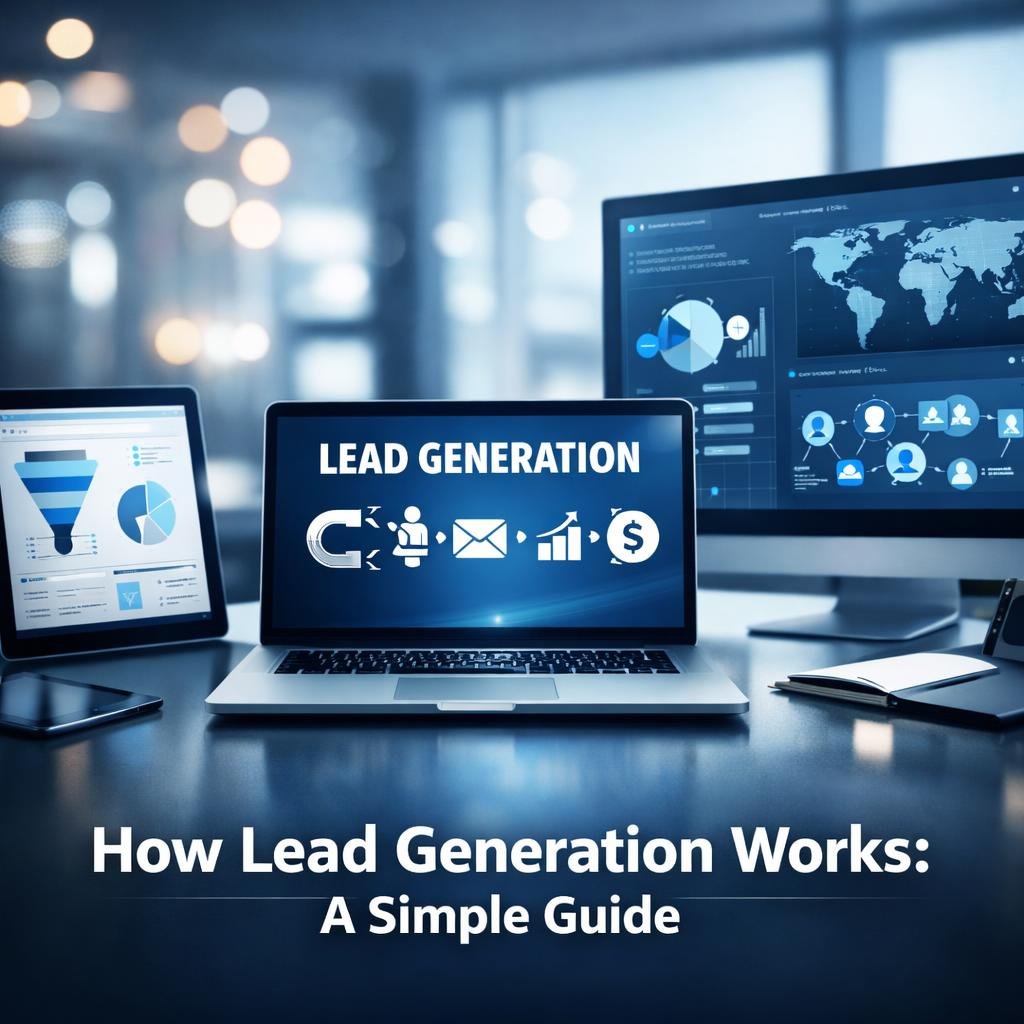
Lead generation is the engine behind sustainable revenue growth. Without a steady flow of interested prospects, even the best product or service will struggle to find buyers. Understanding how this process works — from the first moment someone discovers your brand to the point they become a paying customer — gives you a real advantage in building a predictable sales pipeline.
At its core, lead generation is the process of attracting people who might want what you offer and moving them toward a buying decision. It involves five core stages: attract, capture, qualify, nurture, and convert. Each stage plays a specific role, and a breakdown at any point can stall your entire funnel.
This guide walks you through every stage in plain language. You will learn which channels drive the best results, how to qualify and score leads effectively, which tools support the process, and what mistakes to avoid. Whether you are building your first funnel or fixing one that is underperforming, this breakdown gives you a clear, actionable framework.
Understanding the Lead Generation Lifecycle
What counts as a lead and how it fits into the sales funnel
A lead is any person who has shown interest in your product or service and shared some form of contact information. That could be an email address submitted through an opt-in form, a phone number left after a webinar, or a business card collected at an event. Not every visitor is a lead, and not every lead is ready to buy.
Leads sit in the middle of the sales funnel — below awareness and above the decision stage. They have moved past passive browsing and taken some action that signals interest. Where they go next depends on how well your marketing and sales teams work together.
Key stages: from first touch to sales-qualified opportunity
The journey from first touch to closed deal typically follows a clear progression. Here is a simple overview of how leads move through the funnel:
| Stage | Lead Type | Primary Owner | Goal |
|---|---|---|---|
| Awareness | Visitor | Marketing | Drive traffic |
| Interest | Raw Lead | Marketing | Capture contact info |
| Consideration | MQL | Marketing | Nurture and score |
| Intent | SQL | Sales | Book a meeting |
| Decision | Opportunity | Sales | Close the deal |
Each stage requires different messaging, different tools, and different team involvement. Skipping stages or rushing leads through the funnel is one of the most common reasons conversion rates drop.
Inbound vs outbound lead generation: core differences and when to use each
Inbound marketing pulls prospects toward you through content, SEO, and organic social media. Outbound marketing pushes your message out through cold email, cold calling, and paid acquisition. Both approaches work, but they suit different business models and growth stages.
Inbound tends to produce higher-quality leads over time because prospects self-select based on genuine interest. Outbound can generate results faster but requires more manual effort and a higher tolerance for rejection. Most successful businesses use a blend of both.
Marketing and sales roles: handoffs, lead ownership, and collaboration
Marketing typically owns the top of the funnel — attracting visitors and converting them into leads. Sales takes over once a lead reaches a certain qualification threshold. The handoff between these two teams is where most lead generation programs break down.
Clear definitions of what qualifies as a marketing-qualified lead versus a sales-qualified lead prevent confusion and finger-pointing. Regular alignment meetings, shared CRM data, and agreed-upon lead scoring criteria keep both teams working toward the same revenue goals.
How Lead Generation Works in Practice
Attracting prospects: traffic channels and audience targeting
Before you can capture a lead, you need traffic. The main channels for attracting your target audience include organic search, paid search, social media, referral traffic, and direct outreach. Each channel reaches different segments of your audience at different stages of awareness.
Effective audience targeting means knowing who you are trying to reach — their job title, pain points, buying triggers, and preferred content formats. Without this clarity, your traffic will be high in volume but low in relevance.
Turning visitors into leads: offers, lead magnets, and landing pages
A visitor becomes a lead when they exchange their contact information for something valuable. That value exchange is usually a lead magnet — a free guide, checklist, webinar, template, or trial offer. The stronger and more specific the offer, the higher your conversion rate will be.
Landing pages exist to support this exchange. A well-built landing page removes distractions, communicates the benefit of the offer clearly, and makes the opt-in form easy to complete. Every element on the page should push the visitor toward one action.
Capturing data: forms, CTAs, and balancing friction with lead quality
Your call to action and opt-in form are the final gatekeepers between a visitor and a lead. Shorter forms reduce friction and increase volume. Longer forms add friction but tend to produce more qualified leads because only serious prospects complete them.
The right balance depends on your sales process. High-touch B2B sales often benefit from longer forms that pre-qualify intent. High-volume B2C funnels usually perform better with minimal fields and a strong, direct call to action.
Qualifying leads: MQLs, SQLs, scoring models, and fit vs intent
Lead scoring assigns numerical values to lead behaviors and attributes. Actions like visiting a pricing page, downloading a case study, or opening multiple emails signal higher intent. Demographic fit — company size, industry, job role — signals whether the lead matches your ideal customer profile.
Qualified leads that score high on both fit and intent are the ones most likely to convert. Passing unqualified leads to sales wastes time and damages the relationship between teams. A solid scoring model prevents this.
Nurturing leads: email sequences, content touchpoints, and timing
Most leads are not ready to buy immediately. Lead nurturing keeps your brand visible and builds trust over time through email marketing sequences, retargeting ads, and relevant content. The goal is to stay helpful without being pushy.
Timing matters enormously in nurturing. Sending the right message too early or too late reduces its impact. Behavioral triggers — like a lead revisiting your pricing page — can automate timely follow-ups that feel personal rather than generic.
From lead to customer: sales workflows, follow-up cadences, and closing
Once a lead becomes sales-qualified, the sales team takes over with a structured follow-up cadence. This typically includes a mix of calls, emails, and personalized outreach spread across several days or weeks. Consistency and persistence are key — most deals require multiple touchpoints before closing.
A CRM system tracks every interaction, ensuring no lead falls through the cracks. Sales workflows built inside the CRM automate reminders, log activity, and give managers visibility into pipeline health.
Channels, Tactics, and Tools for Lead Generation
Content-driven lead gen: blogs, guides, webinars, and interactive tools
Content marketing is one of the most cost-effective long-term strategies for generating leads. Blog posts optimized for SEO attract organic traffic from people actively searching for solutions. Guides and webinars capture leads directly by offering deep value in exchange for contact information.
Interactive tools — like calculators, assessments, and quizzes — generate high engagement and strong conversion rates because they deliver personalized results. They also collect rich data about lead preferences and pain points.
Paid acquisition: search ads, social ads, and lead-gen forms
Pay-per-click advertising on search engines puts your offer in front of people actively searching for what you sell. Social ads on platforms like LinkedIn and Meta allow precise audience targeting based on demographics, interests, and behaviors. Both channels can generate leads quickly when managed well.
Native lead-gen forms on social platforms reduce friction by letting users submit their information without leaving the app. These forms work especially well for digital marketing campaigns targeting mobile users.
Organic and community-led tactics: SEO, social media, and events
SEO builds long-term lead generation capacity by ranking your content for high-intent search queries. It takes time to produce results but delivers compounding returns. Social media builds audience relationships and drives traffic to your lead capture assets.
Events — both virtual and in-person — create high-trust environments for customer acquisition. Attendees are self-selected by interest, making them naturally more qualified than cold traffic.
Outbound methods: cold email, cold calling, and prospecting platforms
Outbound marketing requires identifying your target audience, sourcing contact data, and reaching out directly. Cold email works best when it is highly personalized and focused on a specific pain point. Cold calling remains effective in B2B sales when paired with good research and a clear value proposition.
Prospecting platforms like LinkedIn Sales Navigator, Apollo, and ZoomInfo help sales teams find and contact decision-makers at scale. These tools integrate with CRM systems to keep outreach organized and measurable. For a deeper look at B2B tactics that consistently produce results, the strategies behind targeting and messaging make a significant difference in response rates.
Technology stack: CRM, marketing automation, and analytics
A CRM is the foundation of any lead generation operation. It stores contact records, tracks interactions, and manages pipeline stages. Marketing automation tools handle email sequences, lead scoring, and behavioral triggers without manual effort.
Analytics platforms close the loop by showing which channels, offers, and messages drive the best ROI. Without measurement, optimization is guesswork.
Measuring, Optimizing, and Ethical Considerations
Core metrics: cost per lead, conversion rates, and revenue attribution
Cost per lead tells you how efficiently you are generating leads from each channel. Conversion rate measures how well your landing pages, forms, and offers perform. Revenue attribution connects lead sources to actual closed deals, showing which channels deliver the highest customer lifetime value.
Tracking these metrics consistently allows you to make data-driven decisions about where to invest and where to cut.
Improving performance: A/B testing offers, pages, and messaging
A/B testing is the most reliable way to improve conversion rates over time. Test one variable at a time — headline, offer, form length, or call to action — and let data determine the winner. Small improvements compound into significant gains across a high-traffic funnel.
Consistent testing culture separates high-performing marketing teams from those stuck guessing.
Balancing volume and quality: avoiding “junk leads” and burnout
Chasing lead volume without regard for quality burns out your sales team and inflates your cost per acquisition. Junk leads — contacts with no real intent or fit — waste time that could be spent on genuine opportunities.
Tightening your targeting, improving your lead magnets, and refining your scoring model all help shift the balance toward quality. For businesses focused on consumer markets, B2C lead generation approaches that actually convert offer practical ways to attract higher-intent prospects without sacrificing volume.
Compliance, consent, and respecting user privacy expectations
Lead generation must comply with data privacy regulations that govern how you collect, store, and use contact information. Opt-in forms should clearly explain what subscribers are signing up for. Purchased lists carry significant legal and reputational risks.
Respecting user privacy is not just a legal requirement — it builds trust. Prospects who feel respected are more likely to engage and convert.
Common mistakes and how to troubleshoot a broken lead funnel
The most common lead generation mistakes include:
- Sending traffic to a homepage instead of a dedicated landing page
- Using a weak or generic lead magnet that fails to attract the right audience
- Skipping lead scoring and passing every contact directly to sales
- Neglecting nurture sequences after the initial opt-in
- Failing to track which channels actually drive revenue
If your funnel is underperforming, audit each stage separately. Identify where leads are dropping off and test targeted fixes before overhauling the entire system.
Conclusion
Lead generation works when every stage — attract, capture, qualify, nurture, convert — is intentionally designed and consistently measured. No single tactic wins on its own. The results come from how well the stages connect and how tightly marketing and sales collaborate around shared goals.
Continuous testing is non-negotiable. Offers go stale, audiences shift, and channels evolve. Teams that test regularly and adapt quickly maintain a consistent edge over those that set campaigns and forget them.
If you are just starting out, focus on one traffic channel, one lead magnet, and one nurture sequence. Get those working before adding complexity. If you are scaling, invest in lead scoring, CRM automation, and revenue attribution to maximize efficiency. If you are at an advanced stage, focus on channel diversification, sales and marketing alignment, and lifetime value optimization to sustain growth.
FAQ
What is the difference between a lead and a prospect?
A lead is anyone who has shown interest and shared contact information. A prospect is a lead that has been evaluated and determined to be a good fit for your product or service. Prospects are further along in the qualification process and closer to a sales conversation.
How long does it typically take for a lead to become a customer?
The timeline varies widely depending on your industry, price point, and sales cycle complexity. Simple B2C purchases can convert within hours. Complex B2B deals can take weeks or months. Nurturing sequences and consistent follow-up shorten the cycle by keeping your brand top of mind throughout the decision process.
Should small businesses handle lead generation in-house or outsource it?
Small businesses with limited resources often benefit from outsourcing specific functions — like paid ads or cold outreach — while keeping strategy and CRM management in-house. The key is maintaining visibility into what is working. Outsourcing without measurement leads to wasted spend and no learning. Start with clear goals and defined metrics before handing any part of the process to an external partner.