
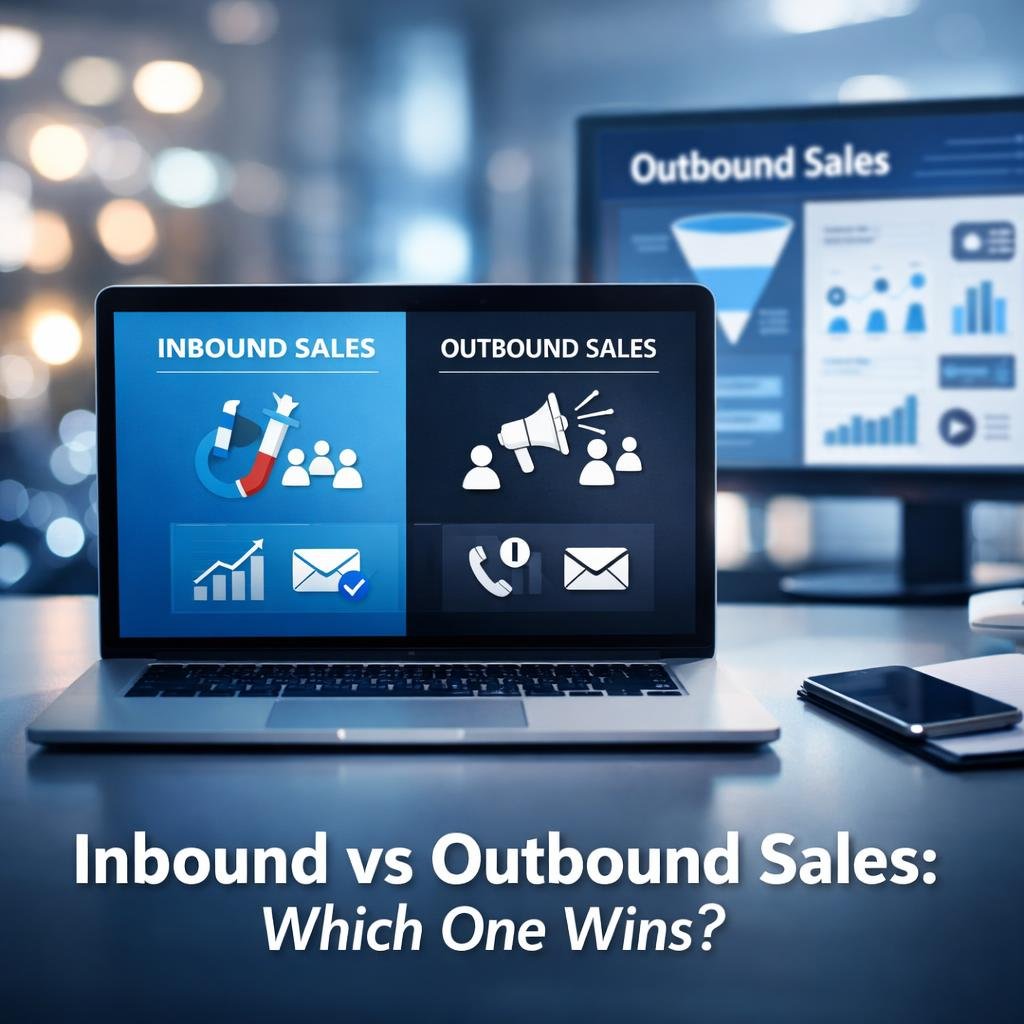
Choosing between inbound and outbound sales is one of the most consequential decisions a sales leader can make. Get it right, and your pipeline fills with qualified buyers who are ready to act. Get it wrong, and you burn budget, exhaust your team, and wonder why conversion rates stay stubbornly low.
The honest answer is that neither approach is universally superior. Each has distinct strengths, cost profiles, and ideal conditions. Understanding those differences — not just at a surface level, but in terms of lead quality, team structure, and long-term ROI — is what separates companies that scale predictably from those that chase their tails.
This guide breaks down both models with clarity and precision. If you are building a sales motion from scratch or rethinking an existing one, understanding how a structured sales process actually works will make everything in this article land with more practical weight.
Inbound vs Outbound Sales: Core Definitions and Key Differences
Before comparing tactics, you need a clean mental model of what each approach actually means. The definitions sound simple, but the implications run deep across your entire go-to-market motion.
Who Initiates Contact: Buyer-Led vs Seller-Led Sales Motion
Inbound sales is a buyer-led motion. The prospect finds you — through a blog post, a search result, a referral, or a piece of content — and raises their hand. Your sales team responds to that interest rather than creating it from scratch.
Outbound sales flips that dynamic entirely. Your team initiates contact through cold calling, cold outreach, direct email, or paid prospecting. The buyer has not asked to hear from you yet. Your job is to earn their attention and build enough trust to move them forward.
This distinction shapes everything: your messaging, your team’s daily workflow, your technology stack, and your cost structure.
Channel Types, Tactics, and Typical Buyer Journey
Inbound sales relies heavily on content marketing, SEO, email marketing nurture sequences, social proof, and inbound marketing assets that attract buyers organically. The buyer journey tends to be self-directed and research-heavy before any sales conversation begins.
Outbound sales uses channels like cold calling, LinkedIn outreach, direct mail, paid advertising, and event-based sales prospecting. The buyer journey is shorter in some cases but requires more persuasion work upfront because the prospect is not yet in an active buying mindset.
- Inbound channels: SEO, blog content, gated assets, webinars, referral programs
- Outbound channels: cold calls, cold email sequences, LinkedIn prospecting, paid ads, trade shows
- Inbound buyer journey: awareness → research → self-qualification → contact
- Outbound buyer journey: interruption → curiosity → qualification → engagement
Sales Funnel Dynamics and Lead Quality Expectations
The sales funnel behaves differently depending on which motion you run. Inbound leads typically enter the funnel already educated. They have read your content, compared options, and often have a specific problem they are trying to solve. That means higher intent and, generally, better conversion rates at the bottom of the funnel.
Outbound leads enter cold. They may fit your ideal customer profile perfectly, but they have not self-selected. This means your sales funnel must do more heavy lifting — educating, building trust, and creating urgency that the buyer has not yet felt on their own.
Neither funnel is inherently better. But understanding which one you are running determines how you staff, train, and measure your team.
| Factor | Inbound Sales | Outbound Sales |
|---|---|---|
| Who initiates contact | Buyer | Seller |
| Lead intent level | High | Low to medium |
| Primary channels | SEO, content, email nurture | Cold calls, outreach, paid ads |
| Sales cycle length | Moderate to long | Variable, often shorter |
| Cost structure | Front-loaded content investment | Ongoing labor and media spend |
| Scalability | High over time | Linear with headcount |
Feature-by-Feature Comparison: Inbound vs Outbound Sales
Now that the foundations are clear, it is worth examining how these two models perform across the specific dimensions that matter most to sales leaders and founders.
Lead Generation, Qualification, and Conversion Workflow
Inbound lead generation compounds over time. A well-optimized piece of content or a strong SEO presence keeps generating marketing qualified leads without additional spend. The qualification workflow typically involves MQL scoring, lead routing, and a discovery call to confirm fit before moving to a sales qualified lead stage.
Outbound lead generation is more immediate but more manual. Sales prospecting involves building target lists, researching accounts, crafting personalized outreach, and managing multi-touch sequences. Qualification happens through the conversation itself rather than through prior content engagement.
- Inbound qualification signals: content downloads, page visits, demo requests, pricing page views
- Outbound qualification signals: ICP match, budget indicators, org size, tech stack, timing cues
- Inbound conversion workflow: MQL → SDR review → SQL → AE handoff → close
- Outbound conversion workflow: prospect list → outreach → connect → discovery → SQL → close
Scalability, Predictability, and Speed to Pipeline
Outbound sales wins on speed. You can launch a cold outreach campaign and have pipeline within days. That makes it attractive for early-stage companies that need revenue now and cannot wait months for content to rank or referrals to accumulate.
Inbound sales wins on scalability and predictability over time. Once your content engine is running and your SEO is established, lead volume becomes more consistent and less dependent on individual rep activity. The customer acquisition cost also tends to decrease as organic traffic compounds.
The tradeoff is timing. Outbound gives you control over when pipeline appears. Inbound gives you efficiency and compounding returns, but requires patience and upfront investment before the flywheel spins.
Team Structure, Skills Required, and Technology Stack
Inbound sales teams typically include content creators, SEO specialists, marketing automation managers, and inbound SDRs who handle lead response and qualification. The sales skills required lean toward consultative selling, active listening, and helping buyers who are already educated make a final decision.
Outbound sales teams need strong prospectors, skilled cold callers, and account executives who can create urgency from scratch. The skills required include resilience, objection handling, research ability, and the capacity to build rapport quickly with strangers.
The technology stack also differs meaningfully:
- Inbound stack: CRM, marketing automation, SEO tools, landing page builders, lead scoring software
- Outbound stack: CRM, sales automation platforms, dialers, LinkedIn Sales Navigator, email sequencing tools, intent data providers
Both motions benefit from a well-configured CRM that tracks every touchpoint and feeds clean data back into your decision-making process.
Data, Attribution, and Feedback Loops
Inbound sales generates rich behavioral data. You can see which content pieces drive the most qualified leads, which pages correlate with higher conversion rates, and where buyers drop off in the buyer journey. Attribution is more traceable when buyers engage with your digital assets before converting.
Outbound attribution is harder. Multi-touch sequences across email, phone, and LinkedIn make it difficult to pinpoint exactly what moved a prospect to engage. That said, outbound generates direct feedback about messaging, objections, and market positioning that inbound rarely surfaces as quickly.
Both feedback loops are valuable, and the best sales organizations use data from both to sharpen their overall sales strategy.
Pricing, Cost Structure, and ROI Considerations
Cost is where many companies make their biggest mistakes. They compare inbound and outbound on surface-level spend without accounting for the full picture of customer acquisition, payback period, and lifetime value.
Customer Acquisition Cost and Payback Period
Customer acquisition cost for inbound sales tends to be lower at scale, but higher in the early stages when content investment has not yet compounded. You are paying for writers, SEO tools, and marketing automation before you see meaningful lead volume.
Outbound customer acquisition cost is more predictable per unit but scales linearly. Every new rep you add increases cost proportionally. The payback period for outbound is often shorter because you can close deals faster, but the cost per acquired customer rarely decreases the way inbound costs do over time.
Media Spend, Content Investment, and Sales Labor Costs
Inbound sales requires significant upfront investment in content marketing, SEO infrastructure, and email marketing systems. These are largely fixed or semi-fixed costs that do not increase dramatically as lead volume grows.
Outbound sales carries higher ongoing labor costs. Sales prospecting is time-intensive, and cold outreach at scale requires either a large team or heavy investment in sales automation tools to maintain personalization without burning out your reps.
- Inbound cost drivers: content production, SEO tools, marketing automation, paid amplification
- Outbound cost drivers: SDR salaries, dialer software, data providers, sales automation platforms, manager oversight
- Hybrid cost drivers: both of the above, offset by higher conversion rates and better pipeline quality
Lifetime Value, Deal Size, and Profit Margin Implications
Inbound leads often close at higher lifetime value because they arrive with stronger intent and a clearer understanding of what they are buying. They have done their research, which means fewer surprises post-sale and better customer retention rates.
Outbound deals can be larger in B2B sales contexts where enterprise accounts require proactive outreach. A well-run outbound motion targeting high-value accounts can generate deals that inbound would never surface simply because those buyers do not search for solutions — they need to be found.
Profit margin implications depend heavily on deal size relative to acquisition cost. A high-volume, low-deal-size business benefits more from inbound efficiency. A low-volume, high-deal-size enterprise business often justifies the labor cost of outbound because each closed deal carries enough margin to absorb it.
Unique Selling Points and Best-Fit Use Cases
The real question is not which model is better in theory — it is which model fits your specific situation right now. Context determines everything.
When Inbound Sales Is Better: Ideal Scenarios and Examples
Inbound sales performs best when your target audience is actively searching for solutions like yours. If buyers are Googling problems you solve, inbound marketing and content can intercept them at exactly the right moment in their buyer journey.
It also works well for companies with a strong brand, a clear content angle, and the patience to invest before seeing returns. SaaS companies, professional services firms, and e-commerce brands with educational content needs are natural fits.
- High search volume around your product category
- Long sales cycles where buyers research extensively before deciding
- Products with broad appeal and a large addressable market
- Teams with content and SEO capabilities already in place
- Businesses prioritizing customer retention and referral-driven growth
When Outbound Sales Is Better: Ideal Scenarios and Examples
Outbound sales is the right choice when your ideal customer does not know they have a problem yet, or when your target audience is too narrow to generate meaningful inbound volume. Enterprise B2B sales almost always requires some degree of outbound because decision-makers at large companies are not browsing blog posts looking for vendors.
It is also the right move when you need pipeline fast. Early-stage startups validating product-market fit, companies entering new markets, and businesses with a very specific ICP that cannot be reached through organic channels all benefit from a disciplined outbound motion.
- Niche target audience with low search volume
- Enterprise accounts requiring multi-stakeholder outreach
- New market entry where brand awareness is near zero
- Short runway requiring fast pipeline generation
- Products solving problems buyers do not yet know they have
Hybrid Strategies: Combining Inbound and Outbound for Maximum Impact
The most effective sales organizations do not choose one or the other — they run both in a coordinated way. Inbound generates warm leads and builds brand awareness. Outbound targets high-value accounts that would never find you organically. Together, they create a more resilient and diversified sales pipeline.
A practical hybrid approach might involve using inbound content to warm up outbound prospects before your reps reach out. When a cold prospect has already seen your content or engaged with your brand, the cold outreach feels less cold. Conversion rates improve, and the sales cycle shortens.
For small businesses thinking through this balance, a clear sales strategy built around your specific resources and market will help you allocate between inbound and outbound without spreading yourself too thin.
- Use inbound content to pre-educate outbound target accounts
- Retarget inbound visitors with outbound paid ads and direct outreach
- Let inbound data inform outbound messaging and objection handling
- Use outbound to test new markets before investing in inbound content
- Align marketing and sales around shared pipeline goals and shared data
Conclusion
Neither inbound nor outbound sales wins universally. Inbound builds compounding, scalable pipeline with lower long-term customer acquisition cost. Outbound delivers speed, precision targeting, and access to accounts that organic channels cannot reach. The right answer depends on your market, your resources, your timeline, and your deal economics.
Most mature sales organizations run both. They use inbound to build authority and attract buyers who are already searching, and outbound to pursue high-value accounts proactively. The companies that struggle are usually those that commit dogmatically to one approach and ignore the strengths of the other.
Start with clarity on your ICP, your sales cycle, and your budget. Then build the motion — or combination of motions — that fits your reality, not someone else’s playbook.
FAQ
Is inbound or outbound sales better for a small but fast-growing business?
For a fast-growing small business, outbound sales often makes more sense in the early stages because it generates pipeline quickly without waiting for content to compound. Once you have revenue and some market validation, layering in inbound marketing creates a more sustainable long-term engine. The key is not to neglect inbound entirely while chasing short-term outbound wins, because the compounding value of content and SEO becomes significant over time.
Can a company rely on only inbound or only outbound sales long term?
Technically yes, but it carries real risk. Companies that rely solely on inbound are vulnerable to algorithm changes, content saturation, and shifts in buyer search behavior. Companies that rely solely on outbound face rising labor costs, rep burnout, and diminishing returns as cold outreach becomes more competitive. A diversified approach that uses both inbound and outbound creates more resilient pipeline and reduces dependence on any single channel or tactic.
How do I decide my initial budget split between inbound and outbound sales?
Start by assessing your sales cycle length, your ICP’s search behavior, and how quickly you need revenue. If you need pipeline within thirty to sixty days, weight your budget toward outbound. If you have six or more months of runway and your buyers actively research solutions online, invest more heavily in inbound content and SEO. A common starting split for B2B companies is sixty percent outbound and forty percent inbound early on, shifting toward a more balanced or inbound-heavy allocation as organic assets mature and begin generating consistent lead volume.