
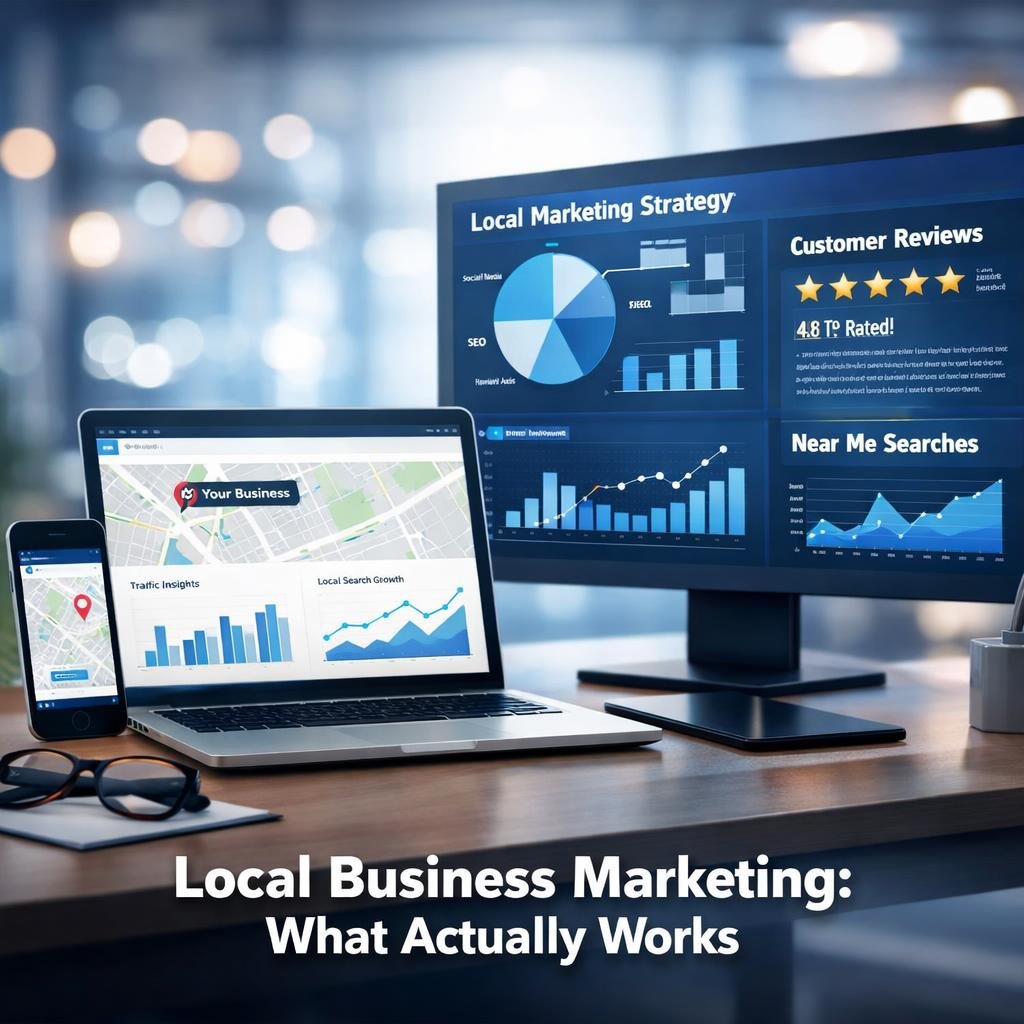
Most small business owners know they need to market locally, but very few have a clear picture of what that actually means or where to start. You might be running a plumbing company, a hair salon, a landscaping service, or a neighborhood café. In every case, your customers live nearby, search nearby, and make decisions based on what they find nearby. That simple fact changes everything about how you should approach marketing.
Local business marketing is not a watered-down version of big-brand advertising. It is a focused, practical discipline with its own tools, strategies, and success metrics. When done right, it consistently delivers customers who are ready to buy, close to your location, and likely to return. This guide breaks down exactly what works, why it works, and how to put it into action without wasting time or money.
What Is Local Business Marketing?
Local business marketing is the process of promoting your products or services to customers within a specific geographic area. It combines digital marketing tools like local SEO, Google Maps, and social media marketing with offline tactics like signage, community events, and word of mouth marketing.
The goal is simple: make your business the most visible, trusted, and accessible option for people in your service area.
| Marketing Type | Focus | Primary Goal |
|---|---|---|
| Local Business Marketing | Specific geographic area | Attract nearby customers |
| General Digital Marketing | Broad or national audience | Scale brand awareness online |
| Content Marketing | Topic-based audience | Build authority and traffic |
Why Local Marketing Matters for Small and Service-Based Businesses
For a small business, competing nationally makes no sense. Your real competition is the three or four similar businesses within a few miles of yours. Local marketing lets you win that specific battle without burning your budget on audiences who will never walk through your door.
Service-based businesses especially depend on local trust. A customer hiring a contractor or a dentist is not just buying a service. They are trusting someone with their home or their health. Local reputation management and customer reviews carry enormous weight in those decisions.
Online vs. Offline Local Marketing Channels
Both channels matter, and the most effective local businesses use both. Online channels include local search, business listings, email marketing, social media marketing, and pay per click advertising. Offline channels include flyers, signage, sponsorships, and in-person community engagement.
The key is choosing channels where your specific customers actually spend their time. A retirement community plumber needs a different mix than a trendy downtown coffee shop targeting younger professionals.
Core Concepts of Local Business Marketing
Defining Your Local Target Audience and Service Area
Before spending a dollar on marketing, get specific about who you serve and where. Your target audience is not just “people in my city.” It includes age range, income level, homeownership status, lifestyle, and the specific problems your business solves.
Your service area should be defined by realistic travel distance, not wishful thinking. Trying to market to everyone usually means reaching no one effectively.
- Map your current customers to find geographic clusters
- Identify the neighborhoods or zip codes that generate the most revenue
- Focus your local SEO and ad targeting on those specific areas first
Positioning Your Business as the Local Choice
Positioning means giving people a clear reason to choose you over the competitor down the street. It is not about being the cheapest. It is about being the most relevant, trustworthy, and memorable option for your specific audience.
Strong local positioning often comes from community ties, specialization, or a distinctive brand personality. A plumber who sponsors the local little league team and has 200 five-star reviews is positioned far better than a competitor with a fancier logo.
Key Elements: Visibility, Trust, Reputation, and Relationships
These four elements form the foundation of effective local business marketing. Visibility means people can find you when they search. Trust means they believe you will deliver. Reputation means your past customers vouch for you. Relationships mean people think of you first because they know you.
Neglect any one of these and your marketing will underperform, no matter how much you spend. A business with great visibility but poor reviews will lose to a competitor with fewer impressions but stronger trust signals.
How Local Search and Maps Listings Work
When someone searches for “electrician near me” or “best pizza in [city],” search engines pull results from a combination of website optimization, business listings, and proximity data. Google Maps plays a central role in surfacing local businesses to mobile users.
Your Google Business Profile is the single most important asset in local search. It feeds your Maps listing, your search panel, and your review visibility. Without it, you are essentially invisible to a massive portion of local searchers.
Step‑by‑Step Setup for Local Marketing Fundamentals
Claiming and Optimizing Your Google Business Profile
Claim your profile at Google’s business platform and verify your location. Fill out every single field: business name, address, phone number, hours, categories, services, photos, and description. Incomplete profiles rank lower and convert worse.
Add real photos of your team, your work, and your location. Businesses with photos receive significantly more direction requests and website clicks than those without.
Ensuring Consistent Business Info Across Directories
Your name, address, and phone number must be identical across every local directory. Inconsistencies confuse search engines and reduce your local SEO rankings. Check platforms like Yelp, Bing Places, Apple Maps, and industry-specific directories.
Use a tool like Moz Local or BrightLocal to audit your listings and fix discrepancies quickly. This is one of the fastest wins available in local search optimization.
Building a Simple, Local‑Focused Website
Your website does not need to be complex. It needs to be fast, mobile-friendly, and clearly focused on your location and services. Include your city and neighborhood in your page titles, headings, and body copy naturally.
Every page should have a clear call to action: call now, request a quote, book an appointment. Website optimization for local intent means making it effortless for a nearby visitor to become a customer.
Setting Up Basic Local SEO (Keywords, Location Pages, Reviews)
Local keywords combine your service with your location. Think “roof repair Austin” or “family dentist Brooklyn.” Use these phrases in your page titles, meta descriptions, and content. If you serve multiple areas, create a dedicated location page for each one.
Reviews are a direct local SEO ranking factor. Encourage satisfied customers to leave Google reviews consistently. Even a steady stream of new local customers often starts with nothing more than a strong review profile and optimized listings.
Creating and Optimizing Local Social Media Profiles
Choose one or two social platforms where your audience is active rather than spreading yourself thin. Fill out your profiles completely with your address, hours, and contact info. Post content that reflects your community involvement, your team, and your work.
Social media marketing for local businesses works best when it feels genuinely local. Tag your city, use local hashtags, and engage with other community accounts.
Practical Local Marketing Tactics You Can Use Right Away
Attracting Customers with Local Search and Online Reviews
The fastest way to attract more local customers is to improve your visibility in local search results and build a strong review profile. Respond to every review, positive or negative. Responses show potential customers that you are attentive and professional.
Ask for reviews at the right moment: right after a job is completed, when a customer expresses satisfaction, or via a follow-up text or email. Make it easy by sending a direct link to your Google review page.
Running Simple Local Ads on Search and Social Platforms
Pay per click advertising on Google lets you appear at the top of search results for specific local keywords immediately. Set tight geographic targeting so your budget only reaches people in your actual service area.
Facebook and Instagram ads offer detailed demographic targeting that works well for local brand awareness campaigns. Start small, test your messaging, and scale what converts. If you are working with limited funds, the guide on marketing a local business on a tight budget offers practical ways to stretch every dollar.
Using Email and SMS to Stay Top‑of‑Mind Locally
Email marketing and SMS are underused by most small businesses. Build a list from every customer interaction: in-store sign-ups, website opt-ins, and post-purchase follow-ups. Send useful, relevant content rather than constant promotions.
A monthly email with a seasonal tip, a local event mention, or a customer spotlight keeps your business present in people’s minds without feeling pushy. SMS works especially well for appointment reminders and time-sensitive offers.
Offline Tactics: Signage, Flyers, Events, and Community Sponsorships
Do not underestimate physical visibility. A well-placed yard sign after completing a job in a neighborhood generates calls from neighbors who saw your work firsthand. Flyers in complementary local businesses reach people who are already spending money nearby.
Community sponsorships build brand awareness and goodwill simultaneously. Sponsoring a local sports team, school event, or charity run puts your name in front of hundreds of engaged community members at a relatively low cost.
Partnering and Cross‑Promoting with Other Local Businesses
Find businesses that serve the same customers but do not compete with you. A wedding photographer can partner with a florist, a caterer, and a venue. A gym can partner with a nutritionist and a sports apparel shop.
Cross-promotions can be as simple as displaying each other’s business cards or as structured as bundled offers. Community engagement through business partnerships builds your network and your reputation at the same time.
Measuring Results and Troubleshooting Common Problems
Basic Metrics to Track for Local Marketing Success
Track the numbers that actually connect to revenue. For local marketing, the most important metrics include phone calls from your Google Business Profile, direction requests, website visits from local search, and new customer acquisition source.
- Google Business Profile insights show calls, clicks, and searches
- Google Analytics tracks local organic traffic and conversion rate optimization data
- Ask every new customer how they found you and record the answers
What to Do If You Are Not Showing Up in Local Search
Start with your Google Business Profile. Confirm it is verified, fully completed, and categorized correctly. Check for duplicate listings that might be splitting your authority. Audit your local directories for inconsistent information.
Build more local citations and earn more reviews to strengthen your local SEO signals. If competitors are outranking you, analyze their profiles and listings to identify gaps in your own setup.
Handling Negative Reviews and Reputation Issues
Negative reviews happen to every business. Respond calmly, acknowledge the issue, and offer to resolve it offline. Never argue publicly. A professional response to a bad review often impresses potential customers more than the negative review harms you.
Reputation management is an ongoing process, not a one-time fix. Consistently generating new positive reviews dilutes the impact of occasional negative ones over time.
Fixing Low Response to Ads, Promotions, or Events
Low response usually points to one of three problems: wrong audience, weak offer, or poor timing. Revisit your targeting to confirm you are reaching people in your actual service area with genuine interest in your category.
Test different offers and messaging. Sometimes a small change in wording or a more specific call to action dramatically improves mobile marketing response rates. Track results per campaign so you know exactly what to adjust.
Conclusion
Recap of What Local Business Marketing Is and Why It Works
Local business marketing works because it focuses your energy on the people most likely to become real customers. It combines online presence tools like local SEO, Google Maps, and customer reviews with offline community engagement to build visibility and trust where it counts most.
The businesses that win locally are not always the biggest or the best-funded. They are the most consistent, the most visible, and the most trusted within their specific community.
Prioritizing Your Next Three Local Marketing Actions
Pick three actions and execute them this week. A strong starting point for most businesses looks like this:
- Claim and fully optimize your Google Business Profile
- Audit your business listings for consistency across all directories
- Ask your last five satisfied customers to leave a Google review
These three steps alone will move the needle faster than most complex strategies.
Building a Sustainable, Community‑Focused Marketing Plan
Sustainable local marketing is built on relationships, not just transactions. Show up consistently in your community, online and offline. Invest in your reputation. Support other local businesses. Treat every customer interaction as a word of mouth marketing opportunity.
The businesses that thrive long-term are the ones their communities genuinely want to see succeed. Build that kind of presence, and your marketing becomes something customers do for you.
FAQ
What is the difference between local business marketing and general digital marketing?
General digital marketing targets broad or national audiences using search engine optimization, content marketing, and paid ads without geographic restrictions. Local business marketing narrows that focus to a specific area, using tools like Google Maps, local keywords, and community engagement to reach nearby customers specifically.
How long does it usually take to see results from local marketing efforts?
Basic improvements like optimizing your Google Business Profile and fixing directory listings can show results within a few weeks. Local SEO improvements typically take two to four months to show meaningful ranking changes. Paid ads and promotions can generate responses immediately once campaigns are live.
Do very small or home‑based businesses really need local marketing?
Absolutely. Home-based businesses often rely entirely on local customers and referrals. A strong online presence, consistent business listings, and active reputation management are just as critical for a solo operator as for a larger company. Small businesses that invest in local marketing consistently outperform those that rely solely on word of mouth.