
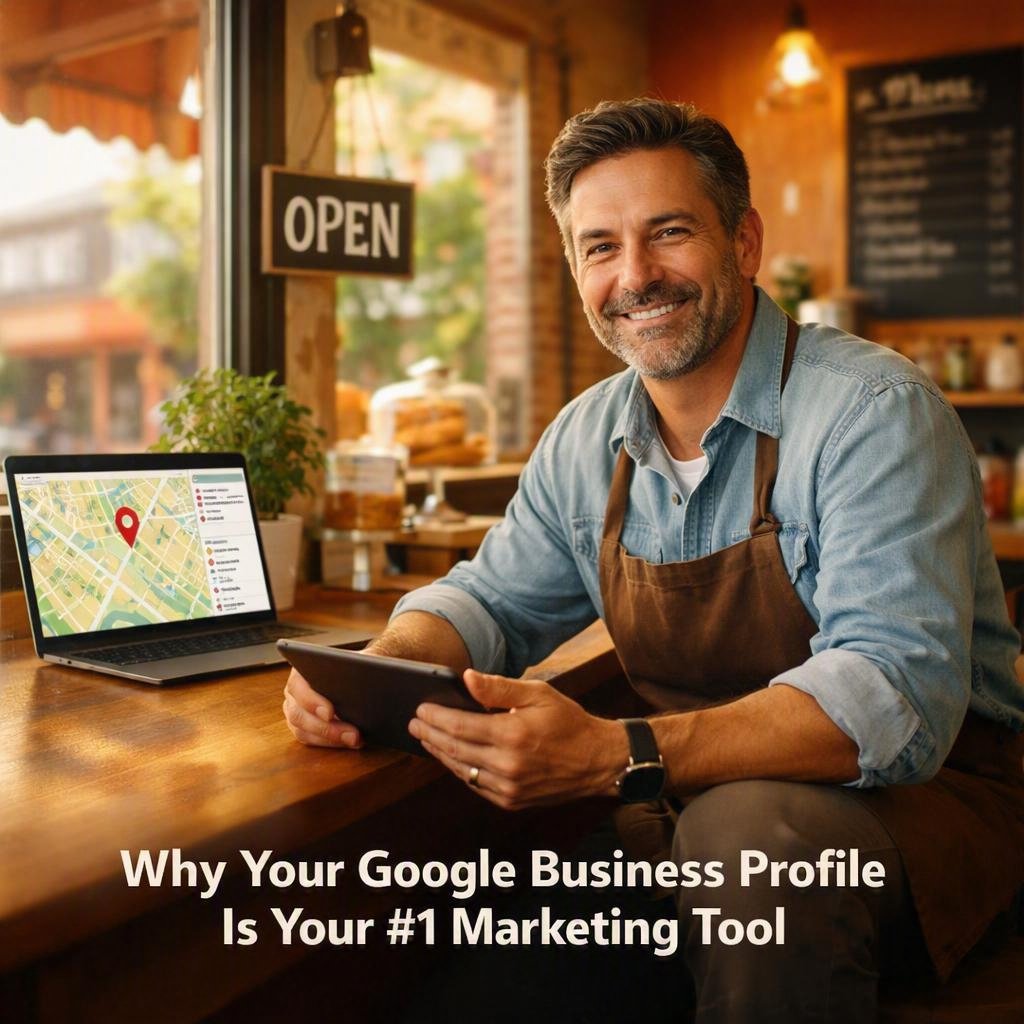
Most business owners spend thousands chasing social media followers, running paid ads, and redesigning their websites. Yet the single most powerful tool for getting found by local buyers costs nothing and sits largely ignored. Your Google Business Profile is the first thing most customers see before they ever visit your site, call your number, or walk through your door.
Think about how you find a plumber, a dentist, or a restaurant. You type something into Google, and a map appears with three businesses listed. That map pack is prime real estate, and your Google Business Profile is your ticket to it. Businesses that optimize their profiles consistently win more clicks, more calls, and more customers than those that don’t.
If you’re serious about attracting new customers to your business, your Google Business Profile is the foundation everything else should be built on. This article breaks down exactly why that’s true and what you can do about it.
Understanding The Strategic Power Of Your Google Business Profile
What A Google Business Profile Is And How It Works In Local Search
A Google Business Profile is a free business listing that appears across Google Search and Google Maps. It displays your business name, address, phone number, hours, photos, reviews, and more — all without requiring someone to visit your website.
When someone searches for a service near them, Google pulls from these profiles to populate local results. The algorithm considers relevance, distance, and prominence to decide which businesses appear. Your profile is essentially your application to be found by high-intent local buyers.
Here’s a quick breakdown of how the profile components work together:
| Profile Element | Primary Function | Impact On Local SEO |
|---|---|---|
| Business Name & NAP | Identifies your business accurately | High — NAP consistency is critical |
| Categories & Attributes | Matches your business to relevant searches | High — directly affects ranking |
| Photos & Images | Builds trust and engagement | Medium — increases click-through rate |
| Customer Reviews | Establishes credibility and social proof | High — star ratings influence clicks |
| Google Posts | Shares updates, offers, and news | Medium — signals active management |
How Your Profile Functions As Your New Digital Storefront
Your Google Business Profile is often the first impression a potential customer gets. Before they see your website, your social media, or your ads, they see your profile. It needs to work hard.
A well-maintained profile answers the questions buyers ask before making a decision: Are you open? Where are you? Are you trustworthy? What do others say about you? When your profile answers these questions clearly and confidently, conversion happens faster.
The knowledge panel that appears on the right side of branded searches gives your business instant authority. It consolidates your most important information in one place, making it easy for customers to act.
The Central Role Of Google In Modern Buyer Journeys
Google Search is where buying decisions begin. Mobile search has made this even more pronounced, with people searching for businesses while they’re already out and ready to spend. The intent behind these searches is high, and your profile is positioned exactly where that intent lives.
Local SEO is not a separate strategy from your broader marketing. It’s the engine that drives foot traffic, phone calls, and website traffic from people who are actively looking for what you offer. Your Google Business Profile sits at the center of that engine.
Visibility, Discoverability, And Trust: Why Your Profile Beats Other Channels
Local Pack, Maps, And Branded Searches: Owning High-Intent Real Estate
The local pack — those three business listings that appear beneath the map in Google Search — captures a massive share of clicks for local queries. Appearing there puts you in front of buyers who have already decided they want a solution. They just haven’t chosen who yet.
Google Maps functions as a discovery platform in its own right. People browse categories, compare businesses, and make decisions directly inside the app. Owning strong placement in both Google Search and Google Maps doubles your exposure without doubling your budget.
Branded searches — when someone types your business name directly — trigger your knowledge panel. This is your chance to control the narrative and make a strong first impression with accurate, compelling information.
Reviews, Ratings, And Social Proof That Build Instant Credibility
Customer reviews are one of the most powerful trust signals available to any local business. Star ratings appear directly in search results, influencing whether someone clicks on your listing before they’ve read a single word about you.
A steady stream of positive reviews signals to both Google and potential customers that your business delivers. Responding to reviews — positive and negative — shows that you’re engaged and accountable. That responsiveness builds brand awareness and trust simultaneously.
NAP consistency across your profile and other online directories reinforces your legitimacy in Google’s eyes. Inconsistent information confuses both algorithms and customers, reducing your online visibility.
Photos, Posts, And Messaging That Humanize Your Brand
Photos and images on your Google Business Profile do more than make your listing look attractive. They give potential customers a feel for your space, your team, and your products before they commit to visiting. Profiles with strong photo libraries consistently outperform those without.
Google Posts let you share updates, promotions, events, and offers directly on your profile. These posts appear in search results and act as a lightweight call to action that drives engagement without requiring a separate campaign.
The messaging feature allows customers to contact you directly from your profile. Enabling this removes friction from the inquiry process and captures demand that might otherwise go to a competitor.
Why A Google Business Profile Often Outperforms Your Website And Social Media
Your website requires someone to already know you exist or to find you through search. Social media requires consistent content creation and algorithm luck. Your Google Business Profile works passively, surfacing your business to people who are actively searching for exactly what you offer.
For local businesses especially, the profile delivers higher-intent traffic than most other channels. Someone who finds you through a local pack search is far more likely to convert than someone who stumbles across a social media post. Understanding the best digital marketing channels for small businesses makes it clear why this one deserves priority attention.
Turning Your Profile Into A Lead-Generating Machine
Optimizing Core Information For Maximum Clicks And Calls
Start with the basics. Your business name, address, phone number, and business hours must be accurate and consistent everywhere they appear online. NAP consistency is a foundational local SEO signal that many businesses overlook.
Your business description should clearly communicate what you do, who you serve, and what makes you different. Write it for humans first, but include natural references to your services and location. Avoid keyword stuffing — Google’s algorithm is sophisticated enough to penalize it.
A complete profile outperforms an incomplete one in every measurable way. Fill out every available field, including attributes that describe your business environment, accessibility features, and payment options.
Using Categories, Attributes, And Services To Match Buyer Intent
Business categories tell Google what type of business you are and which searches you should appear for. Choosing the right primary category is one of the highest-impact decisions you’ll make for your profile. Add secondary categories where relevant, but keep them accurate.
Attributes add nuance to your listing. They tell customers things like whether you offer online appointments, outdoor seating, or free Wi-Fi. These details influence decisions and help your profile match more specific search queries.
The services section lets you list individual offerings with descriptions and prices. This is particularly valuable for service-based businesses because it helps Google match your profile to specific buyer intent searches.
Leveraging Calls, Messages, Bookings, And Q&A To Capture Demand
Every feature on your profile is a potential conversion point. The call button, message feature, and booking integration all reduce the steps between discovery and contact. The easier you make it to reach you, the more leads you capture.
The Q&A section is often ignored, but it’s a significant opportunity. Customers can ask questions publicly, and anyone can answer — including you. Proactively populate this section with common questions and clear answers to control the information buyers see.
Responding quickly to messages and calls signals to Google that your business is active and customer-focused, which can positively influence your local ranking.
Practical Optimization Checklist For Local Businesses
Use this checklist to ensure your profile is working as hard as possible:
- Verify your business listing through Google’s official process
- Complete every section of your profile without leaving fields blank
- Choose the most accurate primary and secondary business categories
- Upload high-quality photos of your location, team, and products
- Maintain consistent NAP information across all online directories
- Actively request customer reviews and respond to every one
- Publish Google Posts regularly to signal active management
- Enable messaging and respond within a few hours
- Populate the Q&A section with helpful, accurate answers
- List all services with clear descriptions and pricing where applicable
Measurement, Maintenance, And Long-Term Strategy
Using Insights And Analytics To Understand Customer Behavior
Google Business Profile Insights provides data on how customers find your listing, what actions they take, and where they’re coming from. This information is genuinely useful for making smarter marketing decisions.
Track metrics like search queries that triggered your profile, the number of calls made directly from your listing, and how many people requested directions. These numbers tell you what’s working and where there’s room to improve. Insights and analytics from your profile can also inform your broader search engine optimization strategy.
Ongoing Management: Updates, Seasonal Promotions, And Reputation Response
Your profile is not a set-it-and-forget-it asset. Businesses that treat it as a living marketing channel consistently outperform those that don’t. Update your hours for holidays, post seasonal promotions, and refresh your photos regularly.
Reputation management is an ongoing responsibility. Responding to negative reviews professionally and promptly demonstrates accountability. It also shows prospective customers that you take feedback seriously, which builds trust even when the review itself is critical.
Common Pitfalls And Compliance Issues To Avoid
Google has strict guidelines for business listings, and violations can result in suspension. Common mistakes include keyword stuffing in your business name, using a virtual office address, and creating duplicate listings.
- Never add keywords to your business name that aren’t part of your actual name
- Use your real, physical address — not a P.O. box or virtual office
- Avoid creating multiple profiles for the same location
- Don’t incentivize reviews in ways that violate Google’s policies
- Keep your profile information consistent with your website and other directories
Competitor analysis can reveal gaps in your own profile. Look at what top-ranking competitors are doing well and identify areas where your profile can be stronger.
Integrating Your Profile With SEO, Ads, And Offline Marketing
Your Google Business Profile works best when it’s part of a connected strategy. Link it to your website to drive website traffic and reinforce your local SEO signals. Use it alongside Google Ads to dominate both paid and organic search results for high-value queries.
Offline marketing can also reinforce your profile. Add a QR code to your receipts, business cards, or signage that links directly to your review page. This makes it easy for satisfied customers to leave feedback and strengthens your online reputation. If you’re building out a broader plan, understanding how to grow a small business fast will help you see where your profile fits into the bigger picture.
Conclusion
Your Google Business Profile is not a minor administrative task. It’s a high-performance marketing asset that works around the clock to put your business in front of buyers who are ready to act. No other free tool delivers the same combination of visibility, trust, and conversion potential for local businesses.
The businesses winning in local search are not necessarily the biggest or the best-funded. They’re the ones that have taken the time to optimize, maintain, and actively manage their profiles. That’s a competitive advantage available to any business willing to put in the work.
FAQ
Is A Google Business Profile really more important than my website?
For local businesses, yes — in many cases. Your profile appears before your website in local search results and answers the most common buyer questions instantly. Your website still matters for depth of information and conversion, but your profile is often the first and most influential touchpoint.
How often should I update or optimize my Google Business Profile?
At minimum, review your profile monthly. Update hours for holidays immediately, post Google Posts at least twice per month, and respond to reviews within a day or two. Treat it like an active marketing channel, not a static directory listing.
What can I do if my competitors outrank my Google Business Profile?
Start with a thorough audit of your profile completeness, category accuracy, and review volume. Then focus on building more genuine customer reviews, improving NAP consistency across the web, and publishing regular Google Posts. Competitor analysis can reveal specific gaps. For businesses working with limited resources, learning how to market a local business on a small budget can help you prioritize the highest-impact actions first.