
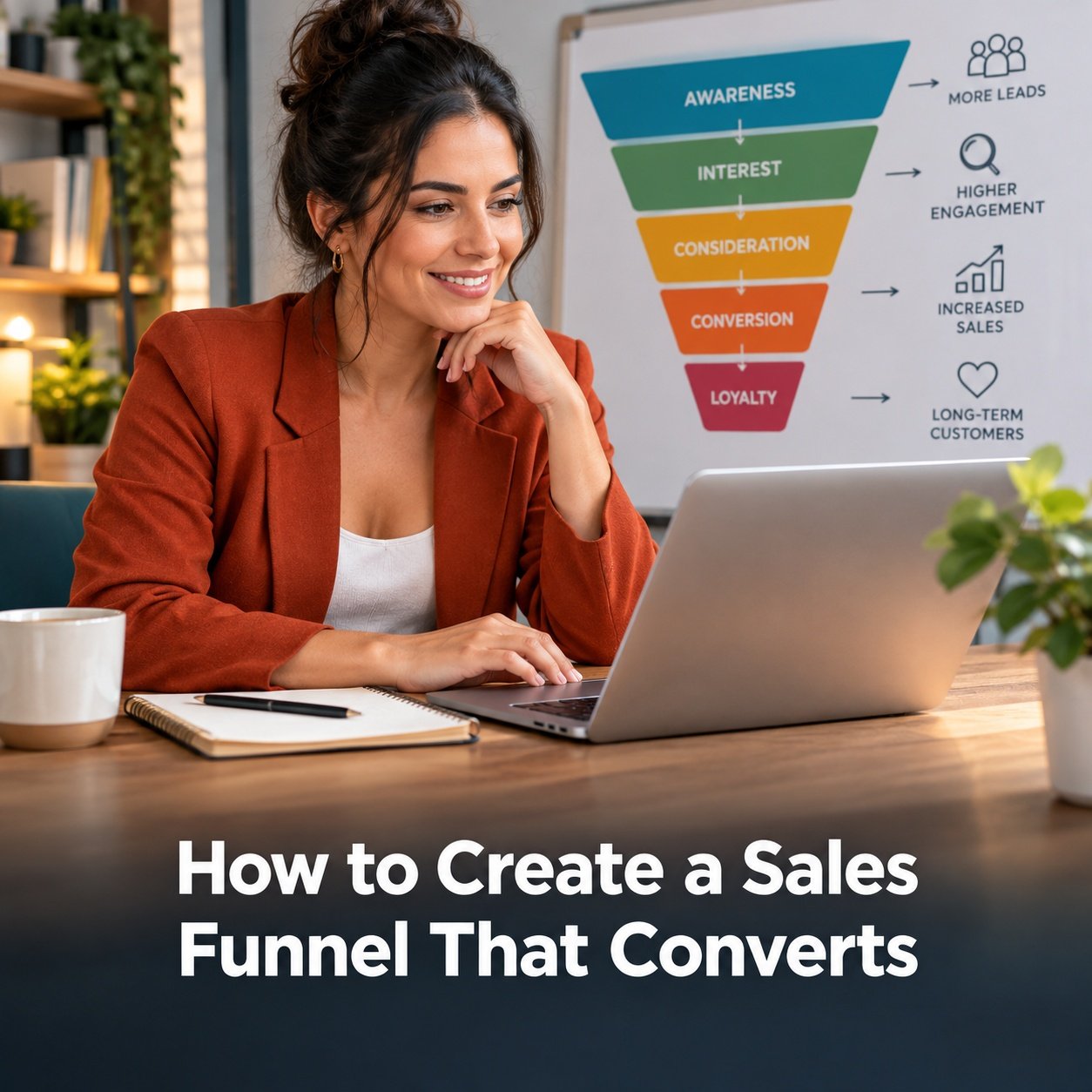
A sales funnel is the structured path that turns a stranger into a paying customer. Every business that generates consistent revenue has one, whether it was built intentionally or evolved by accident. The difference between a funnel that converts and one that leaks money at every stage comes down to planning, execution, and a willingness to measure what actually matters.
Most people overcomplicate the process. They chase the latest tool or tactic without first understanding their customer or clarifying what they want the funnel to accomplish. If you understand how lead generation works at a fundamental level, building a funnel becomes far more logical and far less overwhelming. The goal is to guide the right people toward one clear decision, step by step.
This guide walks you through every stage of building a sales funnel that converts, from initial planning to ongoing optimization. You will learn how to attract the right leads, nurture them effectively, and close sales without relying on pressure tactics or guesswork.
Plan the Funnel Around Your Ideal Customer and Offer
Define the target audience, problem, desired outcome, and buying stage
Before you build anything, you need clarity on who you are building it for. A vague target audience produces vague messaging, and vague messaging does not convert. Your buyer persona should describe a specific person with a specific problem and a specific outcome they want to achieve.
Ask yourself what your ideal customer is struggling with right now. Then ask what they want their life or business to look like after solving that problem. The gap between those two points is where your offer lives.
You also need to understand where they are in the customer journey. Someone who has never heard of your solution needs different messaging than someone actively comparing options. Matching your funnel entry point to the right buying stage dramatically improves your conversion rate from the start.
Match the funnel goal to one primary conversion action
A common mistake is building a funnel that tries to accomplish too many things at once. One funnel should have one primary conversion action. That might be booking a call, purchasing a product, or signing up for a trial. Everything else is secondary.
When you define a single goal, every element of the funnel can be designed to support it. Your copy, your visuals, your call to action, and your email sequence all point in the same direction. This focus is what separates high-converting funnels from cluttered ones.
Your value proposition must be crystal clear before you write a single word of copy. If you cannot explain what you offer, who it helps, and why it matters in two sentences, your funnel will struggle at every stage.
Map the customer journey from awareness to purchase
Mapping the customer journey means identifying every touchpoint between first contact and final purchase. This is not just a theoretical exercise. It helps you spot gaps, redundancies, and friction points before they cost you leads.
Use a simple table to outline each stage and what needs to happen there.
| Funnel Stage | Customer State | Primary Goal | Key Asset |
|---|---|---|---|
| Awareness | Has a problem, unaware of solution | Attract attention | Content, ads, social media |
| Interest | Curious, researching options | Capture lead | Lead magnet, opt-in form |
| Consideration | Evaluating, comparing | Build trust | Nurture sequence, social proof |
| Decision | Ready to buy | Convert to customer | Sales page, checkout |
| Retention | Post-purchase | Deliver value, upsell | Onboarding, follow-up offers |
Each stage requires a different approach. Trying to sell to someone in the awareness stage is like proposing marriage on a first date. Respect the journey and you will earn the sale.
Build the Core Funnel Step by Step
Create a relevant lead magnet that delivers a quick win
A lead magnet is the ethical bribe you offer in exchange for someone’s contact information. It needs to be specific, immediately useful, and directly connected to your paid offer. Generic lead magnets attract generic leads who never buy.
The best lead magnets solve one small but meaningful problem. A checklist, a short guide, a template, a mini-course, or a free tool can all work well depending on your audience. The key is that the person should feel a genuine win within minutes of receiving it.
Your lead magnet also sets expectations. If it is high quality, prospects assume your paid product is even better. If it is thin and disappointing, you have already damaged trust before the sales conversation begins.
Design a focused landing page with a benefit-driven headline, concise copy, trust signals, and one call to action
Your landing page has one job: get the visitor to take the next step. That means removing every distraction, including navigation menus, unrelated links, and competing offers. The page should breathe and load fast.
Start with a headline that speaks directly to the outcome your lead magnet delivers. Follow it with two to three sentences of supporting copy that reinforce the benefit. Then place your opt-in form with a clear, action-oriented call to action button.
- Use social proof such as testimonials, logos, or subscriber counts near the opt-in form
- Keep the form fields minimal — name and email is usually enough
- Add a brief privacy statement to reduce hesitation
- Make the headline the first thing visible without scrolling
Traffic generation is only valuable if your landing page converts that traffic into leads. Even a modest improvement in your opt-in rate can significantly reduce your cost per customer over time.
Set up the thank-you page, lead delivery, tracking, and email automation
The thank-you page is one of the most underused assets in any funnel. Most people treat it as a dead end. Smart marketers use it to deliver the lead magnet, set expectations for what comes next, and sometimes present a low-friction offer immediately after opt-in.
Your analytics and tracking setup should be in place before you send a single visitor to the funnel. Install your tracking pixels, connect your email marketing platform, and confirm that every form submission is being recorded accurately. Broken tracking means broken decisions.
Marketing automation handles the follow-up so you do not have to. Set up a welcome email that delivers the lead magnet instantly, confirms the subscription, and tells the new subscriber what to expect. This first email has the highest open rate of any message you will ever send, so make it count.
Write a nurture sequence that educates prospects, handles objections, and presents the offer
A nurture sequence is a series of emails designed to move a prospect from interested to ready to buy. It is not a broadcast of promotions. It is a structured conversation that builds trust, demonstrates expertise, and addresses the doubts that prevent people from purchasing.
A solid nurture sequence typically runs between five and ten emails. The first few focus on education and value. The middle emails handle common objections. The final emails present the offer clearly and create urgency without being manipulative.
- Email one: Deliver the lead magnet and introduce yourself briefly
- Emails two and three: Teach something genuinely useful related to the problem
- Email four: Share a relevant case study or testimonial
- Email five: Address the most common objection directly
- Emails six through eight: Present the offer, explain the value, and invite action
Every email should have one clear purpose and one call to action. Mixing messages dilutes impact and confuses the reader.
Optimize the sales page, checkout process, and follow-up offers
Your sales page needs to do the heavy lifting of persuasion. It should open with the core problem, present your offer as the logical solution, and back every claim with social proof. Long-form sales pages work well for higher-priced offers. Shorter pages work for lower-priced or well-understood products.
The checkout process is where many funnels lose sales they have already earned. A complicated or confusing checkout creates abandoned carts and lost revenue. Keep it simple, show security badges, and offer multiple payment options where possible.
After the purchase, present an upsell that enhances the original decision. A well-placed upsell can significantly increase your average order value without requiring additional traffic generation. If the customer declines, a downsell at a lower price point gives them another way to say yes. Understanding how to manage your revenue and reinvest it wisely becomes critical once your funnel starts generating consistent sales.
Measure, Improve, and Troubleshoot Conversion Performance
Track traffic, opt-in rate, email engagement, sales conversion, cost per customer, and funnel revenue
You cannot improve what you do not measure. Every stage of your funnel should have a number attached to it. These numbers tell you where the funnel is working and where it is failing.
- Traffic: How many unique visitors reach your landing page
- Opt-in rate: Percentage of visitors who submit the form
- Email open and click rates: How engaged your list is
- Sales conversion rate: Percentage of leads who purchase
- Cost per customer acquisition: Total spend divided by new customers
- Return on investment: Revenue generated relative to total funnel cost
Review these numbers weekly at minimum. Patterns emerge quickly when you pay attention consistently.
Find the weakest transition between funnel stages and prioritize one fix at a time
Every funnel has a bottleneck. It is the point where the most people drop off before taking the next step. Finding that bottleneck is more valuable than randomly tweaking things across the entire funnel.
Fix one thing at a time. If you change your headline, your copy, and your call to action simultaneously, you will not know which change made the difference. Isolate variables and give each change enough time to produce meaningful data before moving on.
Start at the top of the funnel and work down. A low opt-in rate is more urgent than a low email click rate, because fixing the opt-in rate affects every downstream metric automatically.
Run practical tests on headlines, offers, calls to action, forms, pricing, and email subject lines
A/B testing is the discipline of comparing two versions of something to see which performs better. It removes opinion from the equation and replaces it with evidence. You do not need sophisticated software to run useful tests.
Test your landing page headline first, since it has the greatest impact on opt-in rate. Then test your call to action button text. Then test your email subject lines. Each test should run until you have enough data to make a confident decision, typically several hundred impressions or opens at minimum.
Pricing tests can also reveal significant opportunities. Sometimes a higher price with stronger framing converts better than a lower price with weak positioning. Testing removes the guesswork and builds a funnel that improves continuously.
Troubleshoot common problems such as low traffic, poor lead quality, weak engagement, abandoned checkouts, and unclear messaging
Low traffic usually means your traffic generation strategy needs attention. If you are relying on organic reach alone, consider whether paid advertising or a content strategy makes sense for your budget. Learning to market effectively without overspending is a skill that pays dividends at every stage of business growth.
Poor lead quality often traces back to a misaligned lead magnet. If your free offer attracts people who are not genuinely interested in your paid product, your email engagement and sales conversion will both suffer. Tighten the connection between the lead magnet and the core offer.
- Weak email engagement: Improve subject lines, send at better times, or re-examine your content relevance
- Abandoned checkouts: Simplify the process, add trust signals, or send a recovery email sequence
- Unclear messaging: Read your copy aloud and ask whether a stranger would immediately understand the offer
Most funnel problems are messaging problems in disguise. When the right message reaches the right person at the right moment, conversion happens naturally.
Conclusion
Review the complete funnel, confirm that every stage supports the next action, and commit to ongoing measurement and refinement
A finished funnel is never truly finished. It is a living system that responds to your audience, your market, and your offer. The businesses that win are the ones that treat their funnel as an ongoing project rather than a one-time build.
Walk through your funnel from the perspective of a first-time visitor. Does every stage make the next step obvious? Does the messaging stay consistent from the ad to the landing page to the email sequence to the sales page? Gaps in consistency destroy trust and kill conversions.
Commit to reviewing your funnel metrics on a regular schedule. Set a recurring time to look at your numbers, identify the weakest point, and make one focused improvement. Over time, these small improvements compound into a funnel that generates reliable, scalable revenue. If you want to build something that lasts, understanding how to create a sustainable business foundation will make every funnel you build more effective from the start.
FAQ
How many steps should a sales funnel have?
Most effective funnels have four to six core steps: a traffic source, a landing page, a thank-you page, an email nurture sequence, and a sales page with a checkout. You can add complexity over time with upsells, downsells, and retargeting campaigns, but start simple and add only what the data justifies.
What should I do if my landing page gets traffic but few people opt in?
Start with your headline. If it does not immediately communicate a clear, compelling benefit, visitors will leave without reading further. Then check your call to action, your form placement, and whether your page loads quickly on mobile devices. A weak opt-in rate is almost always a messaging or friction problem, not a traffic problem.
How long should I wait before optimizing or changing a funnel?
Give each version of your funnel enough time to collect statistically meaningful data before making changes. For most small businesses, that means waiting until you have at least two hundred to five hundred visitors on a landing page, or at least one hundred email opens on a sequence, before drawing conclusions. Changing things too quickly based on small samples leads to poor decisions and wasted effort.