
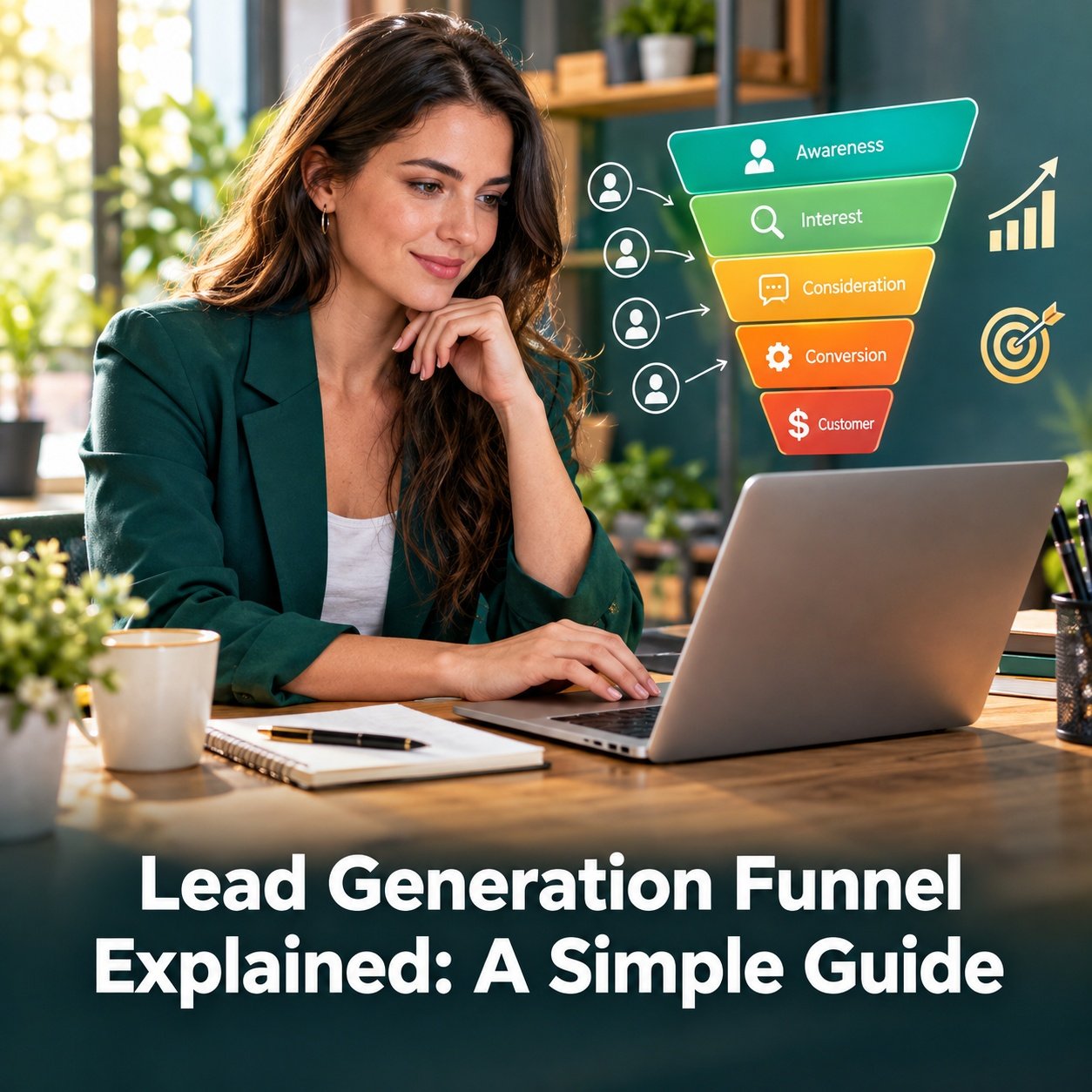
A lead generation funnel is one of the most practical systems any business can build. It takes strangers who have never heard of you and moves them, step by step, toward becoming paying customers. Without a funnel, your marketing efforts are scattered, your follow-up is inconsistent, and most of your potential leads quietly disappear.
The good news is that building a lead generation funnel does not require a massive budget or a large team. What it requires is clarity — knowing who you are targeting, what problem you solve, and how to guide people from first contact to a genuine conversation. Once you understand the structure, you can apply it to almost any business model.
This guide breaks down everything you need to know about the lead generation funnel, from the basic stages to practical optimization strategies. If you have ever wondered why your marketing is not producing consistent results, the answer usually lives somewhere inside your funnel.
What a Lead Generation Funnel Is and How It Works
A lead generation funnel is a structured process that attracts potential customers, captures their contact information, and moves them toward a buying decision. It is called a funnel because many people enter at the top, but only a portion make it all the way through to become qualified leads or customers.
The marketing funnel concept is built around the customer journey. Every prospect goes through a series of mental stages before they are ready to buy, and your funnel is designed to meet them at each stage with the right message.
The Difference Between a Lead Funnel and a Sales Funnel
People often use these terms interchangeably, but they serve different purposes. A lead generation funnel focuses on capturing interest and collecting contact details. A sales funnel that converts takes those captured leads and moves them toward a purchase decision.
Think of the lead funnel as the front end and the sales funnel as the back end. Both are essential, but they require different strategies, content, and calls to action.
The Main Funnel Stages: Awareness, Consideration, Conversion, and Nurturing
| Funnel Stage | Funnel Label | Goal | Common Tactics |
|---|---|---|---|
| Awareness | Top of Funnel (TOFU) | Attract attention | Blog posts, social media, SEO, PPC ads |
| Consideration | Middle of Funnel (MOFU) | Build trust and interest | Lead magnets, email marketing, webinars |
| Conversion | Bottom of Funnel (BOFU) | Capture the lead or sale | Landing pages, forms, offers, demos |
| Nurturing | Post-Capture | Build relationship and qualify | Email sequences, retargeting, calls |
Each stage requires a different approach. The awareness stage is about reaching your target audience. The consideration stage is about showing them you understand their problem. The conversion stage is where you capture their information, and the nurturing stage is where you build enough trust to move them toward a decision.
How Prospects Move from First Contact to Qualified Lead
A prospect typically enters your funnel through a piece of content, an ad, or a referral. They land on a page, see an offer that interests them, and exchange their contact details for something valuable. From there, your email marketing and follow-up sequence takes over.
Not every lead is a qualified lead. Qualification happens through behavior — what emails they open, what pages they visit, and whether they respond to your calls to action. The goal is to identify who is genuinely interested and route them to the right next step.
How to Build a Lead Generation Funnel Step by Step
Building a funnel is a process, not a one-time event. Each component connects to the next, and a weak link anywhere in the chain will reduce your overall results. Start with strategy before you touch any tools or technology.
Define the Ideal Customer and Their Problem
Before you build anything, you need a clear buyer persona. This is a detailed profile of your ideal customer — their industry, role, goals, frustrations, and the specific problem they need solved. The more specific your persona, the more effective every part of your funnel becomes.
Your target audience definition shapes everything: the content you create, the lead magnet you offer, the language on your landing page, and the tone of your emails. Vague targeting produces vague results.
Choose a Lead Magnet and Create a Relevant Offer
A lead magnet is something valuable you give away in exchange for contact information. It should solve a specific problem your ideal customer faces right now. Generic lead magnets produce low-quality leads.
- Checklists and templates
- Free guides or short reports
- Webinars or video training
- Free consultations or audits
- Quizzes or assessments
- Discount codes or free trials
The best lead magnets are specific, immediately useful, and directly connected to your core offer. If your lead magnet attracts the wrong audience, your entire funnel fills with unqualified leads.
Drive Targeted Traffic Through Content, Search, Social Media, or Ads
Traffic is the fuel that powers your funnel. Without consistent, targeted traffic, even the best funnel produces nothing. Your traffic strategy should match your budget, your audience, and your timeline.
- Content marketing and SEO strategy — attracts organic traffic over time through blog posts, guides, and search-optimized pages
- Social media marketing — builds awareness and drives traffic through organic posts and community engagement
- Pay-per-click advertising (PPC) — delivers fast, targeted traffic through paid search and display ads
- Email marketing — re-engages existing contacts and drives them back into your funnel
Most businesses benefit from combining at least two traffic sources. Relying on a single channel creates fragility. If that channel changes or becomes more expensive, your entire lead flow stops.
Create a Landing Page, Form, Thank-You Page, and Follow-Up Sequence
Your landing page has one job: convert visitors into leads. It should have a clear headline, a brief description of your offer, a simple form, and a strong call to action. Remove all distractions, including navigation menus that lead people away.
The thank-you page is often overlooked, but it is a powerful opportunity. Use it to set expectations, deliver the lead magnet, and introduce the next step in your customer journey. Your follow-up email sequence should begin immediately after someone opts in.
A well-structured nurture sequence builds trust before you ever ask for a sale. Aim for three to seven emails that educate, address objections, and guide the lead toward a conversation or purchase.
Qualify, Score, and Route Leads to the Right Next Step
Lead scoring assigns a value to each lead based on their behavior and profile. Someone who opens every email, visits your pricing page, and downloads multiple resources is a much warmer lead than someone who signed up and never engaged again.
Understanding the difference between a raw lead and a qualified lead is critical. You can explore the distinction between customer acquisition and lead generation to sharpen how you think about this process. Routing high-scoring leads to your sales team quickly increases your close rate significantly.
Practical Applications, Metrics, and Funnel Optimization
A funnel that is not measured cannot be improved. Tracking the right metrics tells you exactly where people are dropping off and what needs to change. Optimization is an ongoing process, not a one-time fix.
Examples for Service Businesses, Ecommerce, and B2B Companies
Different business models use lead generation funnels in different ways, but the core structure remains the same.
- Service businesses — often use a free consultation or audit as the lead magnet, followed by a discovery call sequence
- Ecommerce brands — typically use discount codes or free shipping offers to capture emails, then nurture with product recommendations
- B2B companies — commonly use whitepapers, case studies, or webinars to attract decision-makers, followed by a sales development representative outreach
The principles of awareness, consideration, and conversion apply across all three. What changes is the offer, the content format, and the length of the nurturing sequence.
Key Metrics: Traffic, Conversion Rate, Cost per Lead, and Lead Quality
Tracking the right numbers keeps your funnel honest. Vanity metrics like page views feel good but rarely tell you what matters.
- Traffic volume — how many people are entering your funnel at the top
- Conversion rate — the percentage of visitors who become leads on your landing page
- Cost per lead (CPL) — how much you spend to acquire each lead, directly tied to customer acquisition cost
- Lead quality score — how well your leads match your buyer persona and how likely they are to convert
- Return on investment (ROI) — the revenue generated compared to what you spent building and running the funnel
A high conversion rate with poor lead quality is just as problematic as a low conversion rate. Both waste resources and reduce your overall return on investment.
How to Test Offers, Forms, Calls to Action, and Nurture Emails
Testing is how you improve a funnel systematically. Start by testing one element at a time so you know exactly what caused any change in results.
- Test different lead magnet formats to see which attracts higher-quality leads
- Test your landing page headline, since this single element often has the biggest impact on conversion rate
- Test form length — shorter forms typically increase opt-ins but may reduce lead quality
- Test your call to action button text, color, and placement
- Test subject lines and send times in your nurture email sequence
Small improvements compound over time. A five percent increase in landing page conversion rate, combined with a ten percent improvement in email open rates, can dramatically change your overall funnel performance.
Common Problems and Troubleshooting Solutions
Most funnel problems fall into a few predictable categories. Identifying the right problem saves you from making changes in the wrong place.
- High traffic, low opt-ins — your landing page or offer is not compelling enough for your audience
- Good opt-ins, poor lead quality — your lead magnet is attracting the wrong people
- Leads not responding to follow-up — your nurture sequence lacks relevance or arrives too late
- High cost per lead — your traffic source is too broad or your targeting needs refinement
Treat your funnel like a system with inputs and outputs. When results drop, trace the problem back to the specific stage where performance declined.
Conclusion
How to Turn a Basic Funnel into a Repeatable Lead Generation System
A basic funnel captures leads. A repeatable system does it consistently, predictably, and profitably. The difference is documentation, automation, and ongoing optimization. Once your funnel is working, your focus shifts to scaling what is already proven.
Building a strong customer acquisition strategy around your funnel ensures that lead generation feeds directly into sustainable business growth. Map out every step, automate what you can, and review your metrics regularly to catch problems early.
The businesses that win at lead generation are not necessarily the ones with the biggest budgets. They are the ones who understand their funnel deeply, test consistently, and keep improving every stage over time.
FAQ
What Is the Difference Between a Lead and a Qualified Lead?
A lead is anyone who has provided their contact information. A qualified lead is someone who matches your buyer persona, has demonstrated genuine interest, and is likely to benefit from your product or service. Qualification can happen through lead scoring, a discovery call, or specific behavioral signals like visiting your pricing page multiple times.
How Long Should a Lead Nurturing Sequence Be?
There is no universal answer, but most effective nurture sequences run between five and ten emails spread over two to four weeks. The right length depends on your sales cycle. A high-ticket B2B service may require a longer sequence than an ecommerce product. The key is to keep every email relevant and valuable rather than padding the sequence with filler content.
Why Is My Funnel Getting Traffic but Few Leads?
This almost always points to a problem with your landing page or your offer. Your traffic may be well-targeted, but if visitors land on a page that does not immediately communicate value, they leave. Check your headline, your lead magnet relevance, your form placement, and your call to action. Also verify that your page loads quickly on mobile devices, since slow load times alone can cut your conversion rate significantly.