
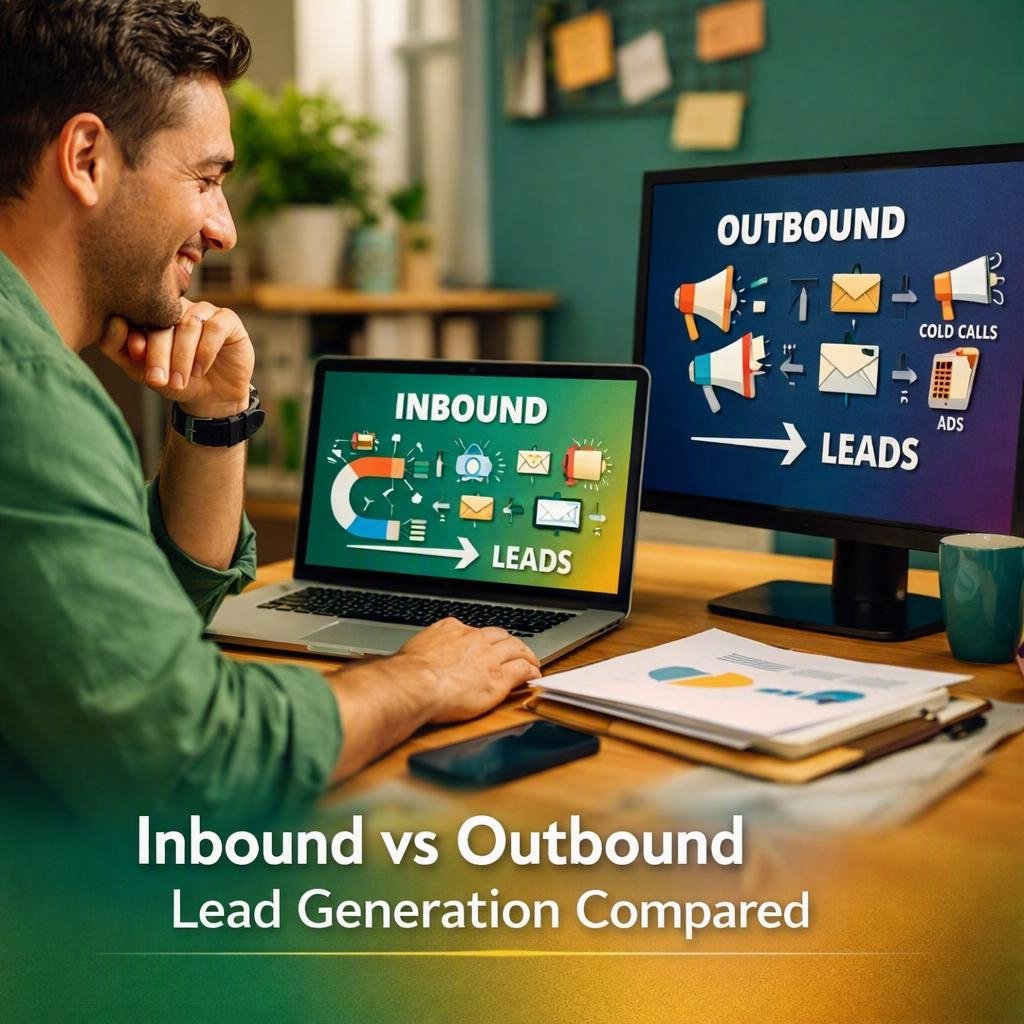
Every business needs a steady flow of new prospects to survive and grow. The real debate isn’t whether to generate leads — it’s how. Two fundamentally different philosophies dominate the conversation: inbound marketing, which pulls prospects toward you, and outbound marketing, which pushes your message out to them. Understanding the distinction between these two approaches is the foundation of any smart growth strategy.
If you’re trying to figure out what lead generation actually is and how it works, the short answer is that it’s the process of attracting and converting strangers into people who have expressed interest in your product or service. Both inbound and outbound methods accomplish this goal — but through completely different mechanisms, timelines, and cost structures.
This comparison breaks down both approaches honestly, without hype. You’ll walk away knowing which method fits your business model, your budget, and your growth goals — and whether combining both might be your smartest move.
Inbound vs Outbound Lead Generation: Core Differences
How each approach works
Inbound lead generation is built on attraction. You create valuable content, optimize it for search engines, and let prospects find you when they’re actively searching for solutions. Think blog posts, SEO-driven landing pages, social media content, and free resources that draw people into your sales funnel organically.
Outbound lead generation flips that model entirely. Instead of waiting for prospects to come to you, you go to them. Cold calling, paid advertising, direct mail, and outreach emails are all outbound tactics. You’re initiating the conversation, often before the prospect has shown any interest.
The core difference is permission. Inbound earns attention; outbound interrupts to get it. Neither is inherently superior — they simply operate on different timelines and assumptions about where your target audience is in their customer journey.
| Factor | Inbound | Outbound |
|---|---|---|
| Initiation | Prospect finds you | You contact the prospect |
| Timeline | Slow build, long-term | Fast results, short-term |
| Cost structure | High upfront, low ongoing | Ongoing spend required |
| Lead intent | High intent | Variable intent |
| Scalability | Scales with content | Scales with budget |
| Control | Lower short-term control | High targeting control |
Buyer intent and audience targeting
Inbound marketing works best when your buyer persona is actively searching for answers. Someone who finds your content through SEO has already identified a problem and is looking for a solution. That intent makes them far easier to convert once they land on your page.
Outbound targets people based on demographic or firmographic data — job title, company size, industry, location. The prospect may not be actively looking, which means your messaging needs to create urgency and relevance from scratch. This requires sharper copywriting and more precise audience segmentation.
Demand generation through outbound can be powerful when you’re entering a new market or launching a product that people don’t yet know they need. Inbound struggles in those scenarios because no one is searching for something they’ve never heard of.
Speed, scalability, and control
Outbound delivers speed. You can launch a cold email campaign or paid advertising push and start seeing responses within days. That immediacy is valuable when you need to fill your sales pipeline quickly or test a new offer.
Inbound takes time. Building SEO authority, growing a content library, and developing a social media marketing presence are months-long investments. The payoff is compounding — content that ranks today can generate leads for years without additional spend.
Scalability works differently for each. Outbound scales with budget: spend more, reach more people. Inbound scales with content and authority: publish more quality content, attract more organic traffic. Control is higher with outbound because you choose exactly who sees your message, when, and how often.
Feature-by-Feature Comparison
Channels and tactics
Inbound marketing channels include:
- SEO and organic search content
- Content marketing through blogs, guides, and videos
- Social media marketing and community building
- Email marketing to nurture existing subscribers
- Landing pages optimized with strong calls to action
- Webinars and free educational resources
Outbound marketing channels include:
- Cold calling and cold email outreach
- Paid advertising on search and social platforms
- Direct mail campaigns
- Trade shows and in-person events
- Account-based marketing targeting specific companies
- Display advertising and retargeting
The channel mix you choose should reflect where your target audience spends time and how they prefer to receive information. A B2B software company might thrive with SEO and account-based marketing combined. A local service business might do better with paid advertising and cold outreach to nearby prospects.
Lead quality and conversion potential
Lead quality is where inbound often wins. A marketing qualified lead who found your business through a search query, read three blog posts, and downloaded a guide is far more educated and motivated than someone who received a cold call. That education shortens the sales cycle and improves conversion rate.
Outbound leads require more nurturing. They haven’t self-selected based on interest — they’ve been selected by you based on fit. That means your sales team needs to do more work to build trust, establish relevance, and move them through the sales funnel.
That said, outbound allows for precision targeting that inbound can’t always match. With account-based marketing, you can identify your ideal customer profile and reach decision-makers directly, bypassing the noise of organic search entirely. For high-value B2B deals, that precision often justifies the extra effort.
Cost structure and pricing differences
Customer acquisition cost looks very different across these two approaches. Inbound has high upfront costs — content creation, SEO tools, marketing automation platforms, and the time required to build authority. But once that infrastructure is in place, the cost per lead drops significantly over time.
Outbound has more predictable but ongoing costs. Paid advertising requires continuous spend. Cold calling requires sales staff or outsourced teams. The moment you stop spending, the leads stop coming. That’s a meaningful distinction when planning long-term budget allocation.
Return on investment calculations also differ. Inbound ROI is harder to measure in the short term but tends to improve over time as content compounds. Outbound ROI is more immediate and trackable — you can see exactly how much you spent on a campaign and how many leads it produced.
For businesses exploring fast growth strategies, understanding these cost dynamics upfront prevents budget surprises and helps set realistic expectations for each channel.
Measurement, attribution, and reporting
Measuring inbound performance requires tracking organic traffic, keyword rankings, time on page, conversion rate from landing pages, and lead nurturing metrics through marketing automation. Attribution can be complex because a prospect might touch five pieces of content before converting.
Outbound measurement is more straightforward. You track open rates, response rates, call connection rates, and cost per lead from paid advertising. Each campaign has a clear start and end, making attribution simpler.
The challenge with outbound attribution is multi-touch scenarios. A prospect might see a display ad, receive a cold email, and then search organically before converting. Giving full credit to any single channel misrepresents what actually drove the decision.
- Use UTM parameters to track paid and email campaign traffic
- Set up goal tracking in analytics for landing page conversions
- Implement CRM tagging to identify lead source at every stage
- Review sales pipeline data regularly to spot conversion bottlenecks
- Track customer acquisition cost monthly to catch efficiency changes
Unique Selling Points and Best Fit Scenarios
When inbound is the better choice
Inbound marketing shines when your buyer persona is research-driven. If your customers spend time comparing options, reading reviews, and educating themselves before buying, content marketing and SEO put you directly in their path at the right moment.
It’s also the smarter long-term play for businesses with limited ongoing budgets. Once your content ranks and your email marketing list grows, the cost per lead continues to fall. That compounding effect is one of inbound’s most powerful advantages.
Inbound works particularly well for:
- SaaS companies with complex products requiring education
- Professional services firms building thought leadership
- E-commerce brands targeting specific niche audiences
- Businesses with longer sales cycles that benefit from lead nurturing
- Companies in competitive markets where brand awareness matters
If your business is still establishing its foundation, understanding the difference between customer acquisition and lead generation will help you prioritize which inbound tactics to build first and which metrics to track as you grow.
When outbound is the better choice
Outbound is the right call when you need results fast. Launching a new product, entering a new market, or recovering from a slow quarter all call for tactics that generate pipeline immediately rather than over months.
It’s also more effective when your target audience is narrow and specific. If you’re selling enterprise software to a defined list of companies, account-based marketing and direct outreach will outperform waiting for those decision-makers to stumble across your blog.
Outbound works particularly well for:
- B2B companies targeting specific industries or company sizes
- High-ticket offers where a single deal justifies significant outreach cost
- New businesses that haven’t yet built organic authority
- Markets where prospects don’t actively search for solutions
- Sales teams that excel at relationship-building and consultative selling
Cold calling still works in many industries, especially when combined with personalized email sequences and social selling. The key is relevance — generic outbound fails, but targeted, research-backed outreach consistently produces results.
When a hybrid strategy works best
Most mature businesses don’t choose between inbound and outbound — they use both strategically. The hybrid approach uses outbound to generate immediate pipeline while inbound builds long-term authority and reduces acquisition costs over time.
A practical hybrid model might look like this: use paid advertising and cold outreach to drive early revenue, then reinvest a portion of that revenue into content marketing and SEO. As inbound traffic grows, reduce dependence on paid channels and shift budget toward nurturing and retention.
Marketing automation is the glue that holds a hybrid strategy together. It allows you to capture inbound leads, segment them by behavior, and trigger personalized follow-up sequences that feel outbound in their specificity but are powered by inbound data.
Account-based marketing is another powerful hybrid application. You identify high-value target accounts through outbound research, then use inbound content — personalized landing pages, targeted ads, and direct email sequences — to engage those specific companies. The result is a highly focused demand generation engine that combines the best of both worlds.
For businesses that want to build something sustainable rather than just chase short-term wins, the hybrid model is almost always the answer. It protects you from over-reliance on any single channel and creates multiple entry points into your sales funnel.
Conclusion
Choosing between inbound and outbound lead generation isn’t a binary decision — it’s a strategic one. Inbound builds long-term authority, attracts high-intent prospects, and reduces cost per lead over time. Outbound delivers speed, precision targeting, and immediate pipeline when you need it most.
The right mix depends on your budget, your timeline, your target audience, and how your buyers make decisions. Start by understanding your customer journey, then build a lead generation strategy that meets prospects where they are — whether that’s a Google search result or a cold email in their inbox.
Both approaches work. The businesses that win are the ones that use them together, measure everything, and keep optimizing.
FAQ
Which is more cost-effective: inbound or outbound lead generation?
It depends on your time horizon. Outbound has more predictable short-term costs but requires continuous spending to maintain results. Inbound has higher upfront investment but delivers compounding returns — content and SEO authority built over time continue generating leads without additional spend. For long-term cost efficiency, inbound typically wins. For immediate results with a defined budget, outbound is more controllable.
Which method produces higher-quality leads?
Inbound leads generally convert at higher rates because they arrive with existing intent and education. A prospect who found you through organic search and engaged with your content has already self-qualified to some degree. Outbound leads require more nurturing and trust-building before they’re ready to buy. That said, outbound through account-based marketing can produce extremely high-quality leads when targeting is precise and messaging is personalized.
Can inbound and outbound be used together?
Absolutely, and for most businesses, combining both is the most effective approach. Use outbound tactics to generate immediate pipeline and test new markets quickly. Use inbound to build sustainable, long-term lead flow that reduces your customer acquisition cost over time. Marketing automation, CRM integration, and consistent measurement across both channels allow you to optimize the full sales pipeline rather than managing two disconnected strategies.