Every business owner hits the same crossroads: spend money on ads and get traffic now, or invest time in organic marketing and build something that lasts. Neither answer is automatically right. The best choice depends on your goals, your budget, your industry, and how much risk you can absorb while waiting for results.
Most marketing advice pushes you toward one extreme or the other. Ad agencies will tell you paid traffic is the fastest path to revenue. Content marketers will tell you SEO and organic growth are the only sustainable strategies. The truth sits somewhere in the middle, and understanding both sides clearly is what helps you make a smarter decision for your specific situation.
This guide breaks down how each approach works, where each one excels, and how to build a digital marketing strategy that actually fits your business. If you are just getting started, it also helps to understand how customer acquisition strategy shapes your entire marketing approach before you commit budget to any single channel.
Understanding Paid Ads vs. Organic Marketing
Before comparing the two, it helps to understand exactly what each one involves and how they operate differently in practice.
What Paid Advertising Is and How It Works
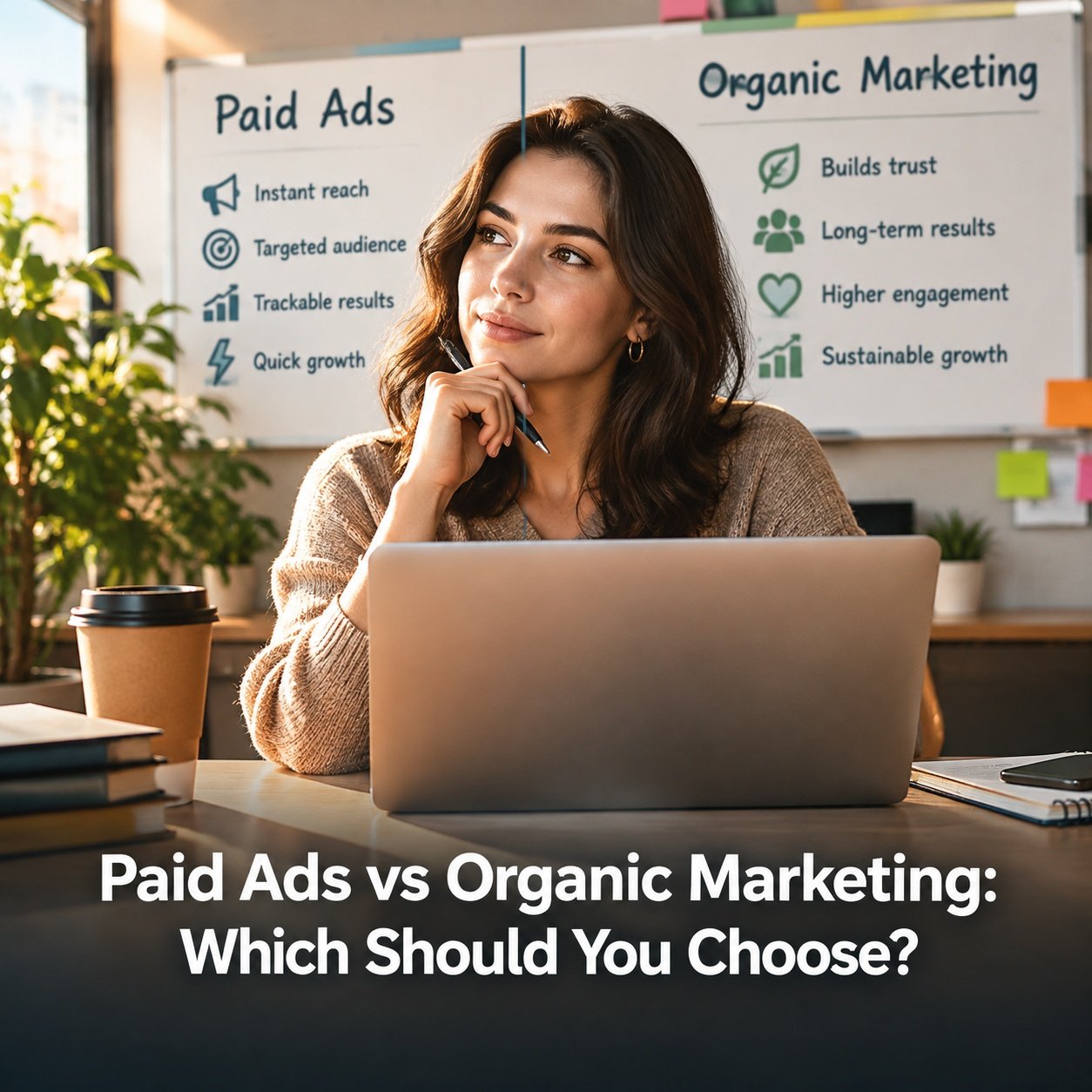
Paid advertising means you pay to place your message in front of a specific audience. This includes Google Ads, social media ads, pay-per-click campaigns, display advertising, and sponsored content. You set a budget, define your target audience, and your ads appear immediately across search engine results pages or social feeds.
The core mechanic is simple: you pay for visibility. Cost per click, impression volume, and conversion rate all determine whether your spend generates a positive return on investment. Stop paying, and the traffic stops.
Paid ads give you control and speed that organic methods simply cannot match. You can test messaging, target specific demographics, and scale what works within days rather than months.
What Organic Marketing Is and How It Works
Organic marketing builds visibility without paying for placement. It includes SEO, content marketing, social media marketing through unpaid posts, email list building, community engagement, and inbound marketing strategies. Traffic comes from people finding you through search engines, referrals, or social sharing.
The investment here is time and effort rather than direct ad spend. You create content, optimize for keyword research targets, build backlinks, and grow an audience gradually. Results compound over time as your content earns authority and ranks higher on search engine results pages.
Organic marketing is slower to start but builds equity that continues delivering value long after the work is done.
Key Differences in Cost, Control, and Time to Results
Here is a straightforward comparison of how these two approaches differ across the factors that matter most to business owners.
| Factor | Paid Advertising | Organic Marketing |
|---|---|---|
| Speed to Results | Immediate | Months to years |
| Cost Structure | Ongoing spend required | Time and content investment |
| Targeting Control | High precision | Limited direct control |
| Long-Term Growth | Stops when budget stops | Compounds over time |
| Brand Awareness | Fast but paid | Slower but earned |
| Scalability | Budget-dependent | Content and authority-dependent |
Evaluating Your Business, Audience, and Goals
The right marketing channel is not universal. It depends heavily on where your business is right now and what you are trying to accomplish.
Stage of Business: Startup, Growth, or Established
A startup with no audience and no organic presence often needs paid advertising to generate early traction. Waiting twelve months for SEO to kick in is not realistic when you need revenue to survive. Paid ads can validate your offer quickly and fund the longer-term organic work.
A growth-stage business typically benefits from running both. Paid campaigns drive immediate leads and sales while organic content builds the foundation for lower customer acquisition cost over time. Established businesses with strong organic traffic can often reduce paid spend and rely more heavily on the authority they have built.
Understanding your stage honestly is the starting point for any smart marketing budget decision.
Clarifying Objectives: Awareness, Leads, Sales, or Loyalty
Your objective shapes everything. If you need brand awareness fast, paid social media ads and display campaigns reach new audiences immediately. If you need lead generation, a combination of SEO-driven content and targeted PPC campaigns tends to work well together.
Sales-focused campaigns often perform better with paid advertising because you can target buyers who are already searching for what you sell. Loyalty and retention, on the other hand, are almost always better served through organic channels like email marketing, community building, and consistent content.
Map your goal to the marketing funnel stage you are targeting before spending a dollar.
Budget, Team Capacity, and Risk Tolerance
A limited marketing budget changes the equation significantly. Paid advertising can drain a small budget fast if campaigns are not optimized properly. Organic marketing requires less direct spend but demands consistent time and skilled execution. If you have neither budget nor time, neither approach will work well.
Risk tolerance also matters. Paid ads carry financial risk if campaigns underperform. Organic marketing carries opportunity cost risk if growth is slower than expected. Knowing how much uncertainty your business can handle helps you decide how aggressively to invest in either direction.
Strengths and Limitations of Paid Ads
Paid advertising has real advantages, but it also comes with trade-offs that catch many businesses off guard.
Speed, Targeting Precision, and Measurability
The biggest advantage of paid advertising is speed. A Google Ads campaign can drive website traffic on day one. Social media ads can put your offer in front of thousands of people within hours. For businesses that need results quickly, this is hard to beat.
Targeting precision is another major strength. You can define your target audience by location, age, interests, search intent, income level, and dozens of other variables. This makes paid campaigns highly efficient when set up correctly.
Measurability is equally strong. Click-through rate, cost per click, conversion rate, and return on investment are all trackable in real time. You know exactly what is working and what is not.
Common Challenges: Ad Fatigue, Rising Costs, and Dependence on Platforms
Ad fatigue is a real problem. Audiences see the same ads repeatedly and stop responding. This forces constant creative refreshes, which adds to both cost and workload.
Cost per click has risen significantly across most platforms. Competitive industries can see extremely high CPC rates, making it difficult for smaller businesses to compete without a substantial marketing budget. Customer acquisition cost climbs as competition increases.
Platform dependence is perhaps the biggest long-term risk. If Google or a social media platform changes its algorithm, raises prices, or restricts your account, your traffic disappears overnight. You own nothing.
Best-Fit Scenarios for Investing in Paid Campaigns
Paid advertising makes the most sense in these situations:
- You have a proven offer and need to scale it quickly
- You are entering a new market and need immediate visibility
- Your sales cycle is short and conversion rates are measurable
- You have the budget to test and optimize campaigns properly
- You are running a time-sensitive promotion or product launch
Strengths and Limitations of Organic Marketing
Organic marketing builds something that belongs to you. That is its core advantage and also the reason it takes longer to deliver results.
Compounding Benefits of Content, SEO, and Community Building
A well-optimized piece of content can drive website traffic for years without additional investment. SEO rankings, once earned, deliver consistent inbound marketing results that compound as your domain authority grows. This is fundamentally different from paid ads, where results stop the moment you stop spending.
Content marketing also builds trust. Audiences who find you through organic search or social sharing already have some level of interest. They are not being interrupted by an ad. That difference in intent often translates to higher engagement and stronger long-term loyalty.
Community building through social media marketing and email creates direct relationships that no platform can take away from you.
Time, Consistency, and Resource Demands
The main limitation of organic marketing is time. SEO results typically take several months to materialize. Building a social media following or email list requires consistent effort over an extended period. Most businesses underestimate how long this takes and give up too early.
Consistency is non-negotiable. Sporadic content production does not build authority. You need a steady publishing cadence, ongoing keyword research, and regular optimization to see meaningful results.
Resource demands are also real. Quality content marketing requires skilled writers, strategists, and SEO knowledge. It is not free just because you are not paying for clicks.
Best-Fit Scenarios for Prioritizing Organic Growth
Organic marketing is the right primary focus when:
- You have a limited advertising budget but time to invest in content
- Your industry has high cost per click rates that make paid ads uneconomical
- You are building a brand that depends on trust and authority
- You want long-term growth that does not depend on ongoing ad spend
- Your target audience actively searches for information before buying
Designing the Right Mix: When to Choose Paid, Organic, or Both
Most successful businesses do not choose one or the other. They design a strategy that uses both intelligently.
Framework for Balancing Short-Term Wins and Long-Term Equity
Think of paid advertising as renting visibility and organic marketing as building an asset. Renting makes sense when you need immediate results. Building makes sense when you are thinking about where you want to be in two or three years.
A practical framework is to use paid ads to generate revenue now while simultaneously investing in organic content that reduces your dependence on paid traffic over time. As organic traffic grows, you can gradually shift budget away from paid campaigns and reinvest it elsewhere. For businesses figuring out how to allocate resources early on, understanding what a realistic small business digital marketing budget looks like is a critical first step.
The goal is to build a marketing engine that does not collapse if one channel underperforms.
Sample Strategies for Different Industries and Business Models
Different business models call for different approaches. Here are a few examples:
- E-commerce: Heavy paid advertising for product launches and retargeting, combined with SEO-driven product descriptions and blog content for long-term organic traffic
- Service businesses: Local SEO and content marketing as the foundation, with Google Ads for competitive keywords where organic ranking is difficult
- SaaS companies: Content marketing and inbound marketing for top-of-funnel awareness, paid PPC campaigns for high-intent bottom-of-funnel keywords
- Professional services: Thought leadership content and community building for trust, with targeted social media ads for lead generation campaigns
Competitive analysis also plays a role here. Understanding what your competitors are doing in both paid and organic channels helps you identify gaps and opportunities in your own digital marketing strategy.
Measuring ROI and Adjusting Your Investment Over Time
Tracking return on investment across both channels requires clear attribution. For paid ads, this means monitoring cost per click, conversion rate, and customer acquisition cost at the campaign level. For organic marketing, it means tracking website traffic growth, keyword rankings, and lead volume from organic sources.
Review performance regularly and adjust your investment based on what the data shows. If paid campaigns are delivering strong ROI, scale them. If organic traffic is growing and converting well, increase your content investment. If you want a deeper look at how lead generation fits into this picture, this guide on how lead generation works covers the mechanics clearly.
Neither channel should be set and forgotten. Both require ongoing optimization to stay effective.
Conclusion
Paid advertising and organic marketing are not competitors. They serve different purposes and work best when used together strategically. Paid ads give you speed and precision. Organic marketing gives you compounding value and independence from platform costs.
The right balance depends on your business stage, your goals, your budget, and your capacity to execute consistently. Start by being honest about where you are and what you actually need right now. Then build a strategy that delivers short-term results while laying the groundwork for sustainable long-term growth.
FAQ
Is paid advertising or organic marketing better for a small budget?
Organic marketing is generally more accessible for businesses with limited budgets because it does not require ongoing ad spend. However, even a small paid advertising budget can be effective if campaigns are tightly targeted and well-optimized. The key is not spreading a small budget too thin across multiple paid channels.
How long does it take to see results from organic marketing compared to paid ads?
Paid ads can generate website traffic and leads within hours of launching a campaign. Organic marketing, particularly SEO and content marketing, typically takes several months before meaningful results appear. Social media marketing and email list building fall somewhere in between, depending on consistency and audience size.
Can I rely only on paid ads or only on organic marketing and still grow?
Yes, but both approaches carry risks when used exclusively. Relying solely on paid advertising creates dependence on platforms and ongoing spend with no lasting asset. Relying solely on organic marketing means slower growth and vulnerability to algorithm changes. Most businesses that grow sustainably use a combination of both, adjusting the balance as their situation evolves.